

Why Is My Preteen So Moody? Understanding the Emotional Changes of Ages 9–12

A preteen is usually a child around ages 9 to 12, in the stage just before adolescence when emotional, social, and physical changes can make reactions seem bigger, faster, and harder to manage. One minute, your child wants to curl up next to you on the couch. The next, they're rolling their eyes because you asked a completely reasonable question. A forgotten water bottle can become a catastrophe, a comment from a friend can ruin the entire evening, and suddenly your once-chatty child responds to everything with, "I'm fine."
If you've found yourself wondering, "Why is my 9-year-old daughter so moody?" or "Why does my 12-year-old have mood swings?", you're certainly not the only parent or caregiver asking. This guide helps you make sense of common preteen emotional changes, why mood swings happen, how patterns can differ between girls and boys, and when shifts in mood may point to anxiety, depression, or other struggles linked to puberty rather than normal ups and downs.
Knowing what is typical can help you respond with more empathy, protect your relationship with your child, and spot when extra support may be needed. You'll also learn what signs deserve closer attention and practical ways to support a moody preteen at home.
What Is a Preteen?
The terms preteen and tween generally describe the years just before adolescence, often around ages 9–12. There isn't one exact age when this stage begins because development happens at different rates.
Puberty is a perfect example. Girls may begin showing signs of puberty as early as age 8, while boys often begin somewhat later. Early adolescence is generally considered to begin around ages 10–13. HealthyChildren.org
That means your nine-year-old may already be experiencing significant physical and emotional changes while another child the same age isn't there yet.
This period is also about much more than puberty. Preteens are developing stronger opinions, becoming increasingly aware of how other people perceive them, placing more importance on friendships, and beginning to separate their identities from their parents.
All of those changes can make emotions feel particularly intense.
At What Age Do Teenage Mood Swings Start?
Parents often ask, "At what age do teenage mood swings start?" The answer is that you may notice them before the teenage years officially begin.
Hormonal changes associated with puberty can affect mood, but there isn't a universal age when mood swings suddenly appear. Puberty varies significantly between children, and physical, cognitive, social, and emotional development are all happening at the same time. HealthyChildren.org
For some families, changes become noticeable around ages 9 or 10. For others, they become more obvious during middle school.
You might notice your child:
Becoming irritated more easily
Crying over things that previously wouldn't have bothered them
Wanting more privacy
Becoming more sensitive to criticism
Worrying more about friendships or fitting in
Moving quickly between wanting independence and wanting reassurance
Reacting strongly when you enforce a limit
Feeling embarrassed more easily
Spending more time alone
Occasional tween girl mood swings and tween boy mood swings aren't automatically cause for concern. Rather than focusing only on whether your child is "moody," look at the intensity, frequency, duration, and impact of the changes you're seeing.
Why Are Preteens So Emotional?
It's tempting to blame every slammed door on hormones, but the emotional changes of preteens are more complicated than that.
Puberty and Physical Changes: How Their Bodies Are Changing
Hormonal changes during puberty can contribute to changes in mood, while rapid physical development and other physical changes can make children feel self-conscious or uncomfortable in their changing bodies. The prefrontal cortex is still developing at this stage, and it helps with impulse control and logical decision-making. HealthyChildren.org
Puberty can also happen earlier or later than it does for friends. Being the first child in a class to develop—or feeling like the last—can add another layer of self-consciousness.
Your child may not have the language to say, I feel uncomfortable because my body is changing and I'm worried everyone notices.
Instead, you might hear, "Leave me alone!"
Friendships Suddenly Feel Much More Important
A disagreement with a friend that seems relatively small to an adult can feel enormous to a preteen.
Peer acceptance and social status become increasingly important during this stage. Preteens can also become very aware of being evaluated by others and more self-conscious about their appearance. HealthyChildren.org
They're navigating group chats, changing friendships, exclusion, comparison, school dynamics, and increasingly complicated social rules—sometimes all at once.
When your child comes home devastated because someone didn't sit next to them at lunch, try resisting the urge to immediately say, "You'll be fine."
To them, this really does matter.
They Want Independence—But Still Need You
Preteens often begin asking for more privacy and independence and may push back more strongly against parental limits. That's a normal part of early adolescence. HealthyChildren.org
The confusing part is that they still need tremendous amounts of reassurance, connection, and guidance.
One evening, your child may insist they're old enough to handle everything themselves. The next, they may crawl into your bed because something happened at school.
Both can be developmentally appropriate.
School Is Getting Harder
Academic and extracurricular expectations often increase during these years, too.
Children may begin comparing their grades, athletic ability, appearance, popularity, and achievements to those of their peers. A child who has perfectionistic tendencies or anxiety may feel especially overwhelmed by performance expectations.
In fact, school performance and social status are common sources of anxiety for preteens and adolescents. AACAP
Sometimes a child's bad mood after school has much more to do with everything they've been holding together throughout the day than what's happening at home. If your child listens at school but melts down at home, this release can be especially noticeable during the preteen years.
Tween Girl Mood Swings vs. Tween Boy Mood Swings
Parents sometimes wonder whether mood changes look different in girls and boys.
There can be differences in when puberty begins, but we wouldn't encourage parents to rely too heavily on gender stereotypes when interpreting their child's emotions. One child may become tearful and seek reassurance, while another becomes irritable and withdraws. A third might seem perfectly fine at school and unravel every evening at home.
Personality, temperament, family dynamics, stress, neurodevelopment, life experiences, and coping skills all influence how children express difficult emotions.
Rather than asking whether your child's behavior is typical for a tween girl or tween boy, ask:
"Is this typical for my child?"
Changes from their baseline can tell you much more.
Can Puberty Affect Mental Health and Cause Anxiety?
Parents frequently ask, "Can puberty cause anxiety?"
Puberty itself doesn't mean a child will develop an anxiety disorder. However, adolescence brings biological, social, and environmental changes that can coincide with anxiety becoming more noticeable. Anxiety disorders commonly begin during childhood or adolescence, and preteens frequently worry about areas such as school performance and social status. AACAP
Anxiety in preteens doesn't always look like a child saying, "I'm anxious."
It may look like:
Irritability
Frequent reassurance seeking
Avoiding activities they previously enjoyed
Perfectionism
Trouble sleeping
Stomachaches or headaches
Refusing school
Becoming extremely upset about mistakes
Worrying excessively about friendships
Difficulty handling uncertainty or changes in plans
This is why it's worth looking beneath behavior rather than assuming a child suddenly has an attitude problem.
If several of these patterns sound familiar, therapy for childhood anxiety can help kids better understand their worries and develop healthier ways to cope.
Can Puberty Cause Depression?
Can puberty cause depression? Again, it's more accurate to say that puberty occurs during a developmental period when depression can emerge rather than saying puberty alone causes depression.
Depression can occur in younger children, but it becomes more common during adolescence. Research also shows an increase in depression prevalence around puberty, particularly among girls. AACAP
This distinction matters because depression shouldn't be dismissed as normal teenage moodiness, and the symptoms are more concerning when a child shows a clear loss of interest in activities they used to enjoy.
A preteen having a terrible afternoon after an argument with a friend is very different from a child who has seemed persistently unhappy, withdrawn, irritable, or uninterested in things they once loved for more than 2 weeks, since persistent sadness lasting that long is more concerning than a brief bad stretch.
When Are Preteen Mood Swings More Than Typical?
One difficult week doesn't necessarily indicate a mental health concern.
Instead, pay attention to patterns and changes in functioning. The American Academy of Pediatrics recommends watching for changes such as withdrawal from friends and family, loss of interest in favorite activities, changes in sleep or eating, new academic struggles, persistent worries, substance use, or signs of self-harm. HealthyChildren.org
Consider talking with your child's pediatrician or a mental health professional for an assessment when child extreme mood swings affect friendships and everyday life, not just mood itself:
Are becoming more frequent or intense, which may mean your child could benefit from support
Continue for an extended period
Interfere with school, friendships, or family life
Include significant aggression
Come with persistent sadness or anxiety
Lead your child to stop doing things they normally enjoy
Are accompanied by major changes in sleep or appetite
Seem dramatically different from your child's usual personality
Include statements about hopelessness, worthlessness, self-harm, or not wanting to be alive, which are serious concerns and make early intervention and prompt professional attention critical
Big reactions can also show up as anger rather than sadness or worry. We talk more about this in Why Does My Child Get So Angry Over Small Things?
Persistent or extreme anxiety and sadness warrant professional attention rather than being assumed to be normal development. CDC
If you're concerned about your child's safety or suicidal thoughts, seek urgent professional help; in the U.S., you can call or text 988 for crisis support. CDC
6 Ways to Support a Moody Preteen Without Walking on Eggshells
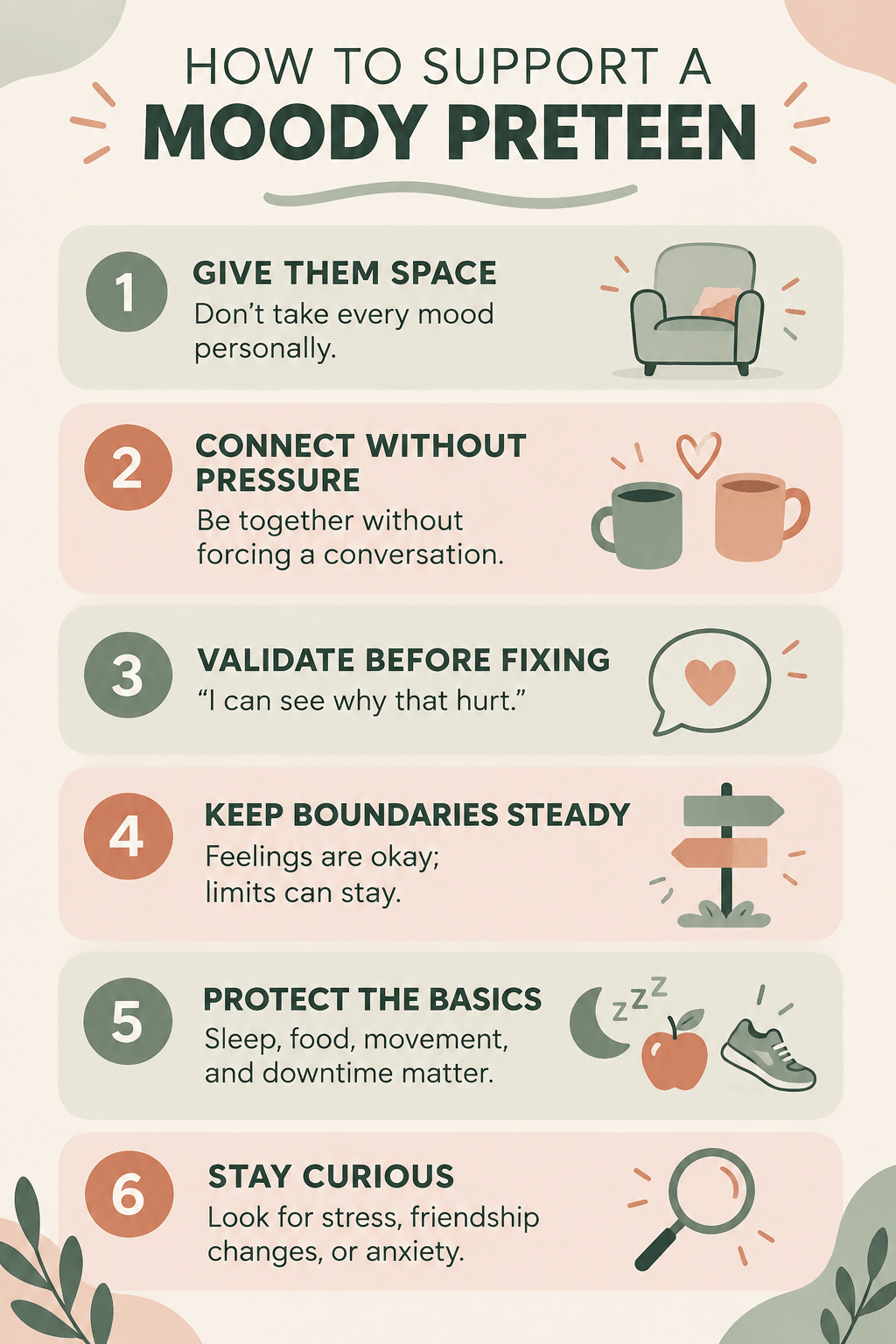
Understanding your child's behavior doesn't mean the entire family needs to reorganize itself around their moods. Preteens still need limits, expectations, and accountability.
The goal is to create enough emotional safety that they can come to you when something really is wrong.
1. Don't Take Every Mood Personally
Your child walks through the door, you ask how school was, and they snap, "Fine!"
It's tempting to immediately correct the tone.
Sometimes that's appropriate. But other times, give them a little room to decompress before assuming the reaction is about you.
Try:
"Sounds like you need a little space. I'm here when you're ready."
You can address disrespect later if necessary without escalating an already overwhelmed child.
2. Create Connection Without Forcing Conversation
Preteens don't always want to sit across from you and discuss their feelings.
Connection may happen while you're driving, walking the dog, making dinner, shooting hoops, or getting ice cream.
Create opportunities to be together without making every interaction an emotional check-in. Sometimes children talk more when talking isn't the stated purpose. In those moments, listen without rushing in, since actively listening fosters better communication and makes it easier for them to speak.
3. Validate Before You Fix
If your child tells you they weren't invited to something, your instinct may be to solve the problem.
"Invite someone else!"
"You have plenty of other friends."
"I'm sure they didn't mean anything by it."
Try validation first:
"Ouch. I can understand why that hurt."
You don't have to agree with your child's interpretation to acknowledge their feelings.
4. Keep Boundaries Predictable
Moodiness doesn't mean expectations disappear.
Your preteen can be furious that their phone has to charge outside the bedroom and still be expected to follow the rule.
Try:
"I know you don't like this rule. You're allowed to be frustrated with me. The phone still stays downstairs tonight."
Warmth and boundaries can exist at the same time. In fact, this balance is an important part of gentle parenting and the authoritative parenting style.
5. Protect the Basics
Sleep, food, exercise, physical activity, downtime, and predictable routines matter.
When schedules become packed with school, sports, homework, social events, and screens, kids may have very little time to recover. The CDC recommends 60 minutes of physical activity each day for children and adolescents, and that activity can boost mental health and wellbeing. Stress in children can show up as irritability, sleep problems, fatigue, tantrums, and changes in cooperation or school performance.
Before assuming every emotional change requires a complicated intervention, take an honest look at your child's daily rhythm. Preteens generally need 9–11 hours of sleep, while adolescents typically need 8–10 hours for better mood regulation.
6. Stay Curious About What Changed
If your child suddenly seems different, don't stop at "puberty."
Ask yourself:
Has something changed with friends or in play?
Is school becoming more stressful?
Are they sleeping enough?
Have they experienced recent shifts in mood or behavior across settings?
Are they dealing with bullying or exclusion?
Are they struggling academically?
Is social media or too much screen time affecting them, contributing to anxiety or sleep disruption?
Have family circumstances changed?
Are they worried about their body or development?
You can also make a short list of personal “mood busters” to help them cope when emotions run high.
You may not get an answer immediately. Continuing to make yourself available matters, and collaborative problem-solving can help them feel some ownership over solutions.
What Preteens Need Most From Their Parents
The preteen years can feel like an uncomfortable middle ground for parents, too.
Your child may need you intensely while simultaneously pushing you away. You may miss how easy it once was to know what was wrong. And when every question seems to earn an eye roll, it can be tempting to stop asking, which is why many parents wonder what is typical as kids move toward the more emotionally complex years that eventually shape adults.
Don't.
Your role is changing, but it isn't becoming less important.
Your preteen needs increasing independence alongside the reassurance that you're still paying attention, and they often respond best when you offer appropriate choice and challenge instead of only directives. They need privacy without isolation, boundaries without humiliation, and a parent who can tolerate their difficult emotions without needing to immediately make those emotions disappear.
You won't handle every interaction perfectly. Neither will they. The relationship has room for both of you to figure this out.
If you're finding it difficult to balance connection, boundaries, and your child's growing need for independence, parenting support can help you find strategies that fit both your child's needs and your family's values.
Therapy with a Mental Health Professional for Preteens in Eden Prairie, Minnesota
Sometimes moodiness is part of growing up. Sometimes it's a child's way of showing us they're struggling.
If your preteen's mood has changed significantly, anxiety is interfering with daily life, emotions regularly feel overwhelming, or you're simply having trouble figuring out how to connect with your child during this new stage, therapy can provide another layer of support.
At Creekside Counseling in Eden Prairie, Minnesota, our therapists provide child and preteen therapy for families throughout the Twin Cities, including support for anxiety and emotional regulation, trauma, behavioral concerns, and life transitions. We also offer parenting support to help parents feel more confident navigating these changing years.
Therapy can give your child a safe place to make sense of what they're experiencing while giving you practical tools to stay connected as your relationship changes. You don't have to wait until things are in crisis to ask for support.
Frequently Asked Questions About Preteen Mood Swings
Why is my 9-year-old daughter so moody?
Mood changes can begin before the teenage years, especially as children enter puberty and become more aware of friendships, appearance, school performance, and other people's opinions. A 9-year-old may also have bigger emotions without yet having the skills or language to explain what's bothering her. Rather than assuming it's "just hormones," pay attention to what tends to happen before the mood change and whether you've noticed other changes in sleep, friendships, school, or behavior.
Why does my 12-year-old have mood swings?
At 12, children are experiencing significant physical, social, and emotional changes. They may want more independence while still needing reassurance and connection from their parents. Occasional mood swings can be developmentally typical, but frequent or extreme mood changes that interfere with school, relationships, or daily life deserve a closer look.
At what age do teenage mood swings start?
There isn't one age when teenage mood swings begin. Some parents notice emotional changes around ages 9 or 10, while others don't see significant changes until the middle school or teenage years. Because puberty and emotional development happen at different rates, it can be more helpful to compare your child's behavior with their own typical mood and personality rather than with other children their age.
Can puberty cause anxiety?
Puberty doesn't automatically cause an anxiety disorder, but the changes surrounding puberty can make anxiety more noticeable. Preteens are navigating changing bodies, increasingly complicated friendships, academic pressure, greater independence, and concerns about fitting in. Anxiety can sometimes appear as irritability, perfectionism, reassurance seeking, avoidance, physical complaints, or difficulty sleeping rather than obvious worry.
Can puberty cause depression?
Puberty alone doesn't necessarily cause depression, but depression can emerge during the preteen and teenage years. Persistent sadness or irritability, withdrawal, loss of interest in activities, significant sleep or appetite changes, hopelessness, or declining functioning shouldn't automatically be dismissed as hormones or typical teenage behavior. If you're concerned about a significant change in your child's mood, reach out to their pediatrician or a mental health professional.
What is the difference between normal preteen moodiness and extreme mood swings?
Normal preteen mood changes tend to come and go, often in response to identifiable stressors, and your child generally returns to their usual self. Child extreme mood swings may be more intense, frequent, prolonged, or disruptive. If emotions are regularly affecting school, friendships, family relationships, sleep, or everyday activities, it may be helpful to seek professional support.
How should I respond when my preteen is in a bad mood?
You don't necessarily need to fix a child's bad mood. Give your child some room to decompress while letting them know you're available. You can validate the emotion without allowing disrespectful behavior: "It seems like you've had a rough day. You can have some space, and I'm here if you want to talk. It's okay to be upset, but it's not okay to speak to me that way." This helps your child learn that difficult emotions are manageable without removing healthy family boundaries.

About the Author
Elisabeth Emmerich, MSW, LICSW, is the owner and founder of Creekside Counseling, where she helps children, parents, and adults build healthier relationships with themselves and those they love. As a mom of three, she understands firsthand the challenges of balancing family life, mental health, and the pressures of everyday life, bringing both professional expertise and personal understanding to her work.