

Why Gentle Parenting Feels So Hard (And What Parents Are Missing)

You promised yourself you weren't going to yell.
Then your child refused to put on their shoes for the fifth time, hit their sibling, and completely ignored your attempt to calmly explain why everyone needed to leave the house. Suddenly, the gentle response you had planned feels very far away.
If you've tried gentle parenting and found yourself thinking, How am I supposed to stay calm through all of this?, you're not alone. Gentle parenting is a parenting approach built on empathy, respect, emotional connection, and understanding children's behavior through a developmental lens—not fear, shame, or harsh punishment—and it works best when warmth is paired with clear, consistent limits (source). Many parents and caregivers want to raise emotionally healthy children this way, but actually putting those ideas into practice—especially when you're tired, overstimulated, or dealing with challenging behavior—is another story.
As therapists who work with children and parents, we also see another problem: gentle parenting is frequently misunderstood. Somewhere along the way, being responsive to children's emotions started getting confused with avoiding boundaries altogether. That's where many families get stuck, because children need both connection and predictable structure.
Healthy gentle parenting isn't about letting children do whatever they want. It's about combining warmth and connection with clear, consistent limits. In this article, we'll break down what gentle parenting is, how it differs from permissive and authoritarian parenting, why it can feel so hard in real life, the common misconceptions and downsides, and practical ways to make it more sustainable.
What Is Gentle Parenting?
So, what is gentle parenting, exactly?
Gentle parenting is a broad parenting philosophy. The gentle parenting approach is an evidence-based approach centered on empathy, respect, understanding, and boundaries. The term was coined by Sarah Ockwell-Smith. Instead of immediately asking, "How do I make this behavior stop?" parents are encouraged to create emotional safety, respond with responsiveness, and get curious about what might be driving it through the lens of child development.
A four-year-old screaming because it's time to leave the playground isn't necessarily trying to make your afternoon difficult. They may be disappointed, tired, hungry, struggling with transitions, or simply lacking the emotional regulation skills to handle the moment differently.
Understanding that doesn't mean you stay at the playground indefinitely.
You can say, "I know you really want to stay. It's hard to leave when you're having fun. And it's time to go."
The feeling is accepted. The boundary remains, which helps with children's feelings by giving them room to express their feelings openly and learn to understand and manage their emotions.
That combination is at the heart of effective gentle parenting.
Gentle Parenting vs. Permissive Parenting: They're Not the Same Thing
One of the biggest misconceptions we see involves gentle parenting vs. permissive parenting.
Permissive parenting tends to describe permissive parents as warm but imposing few rules and allowing children significant freedom. Parents may avoid saying no, change boundaries when a child becomes upset, or feel responsible for keeping their child happy.
Healthy gentle parenting still includes boundaries, consequences, expectations, and adult leadership to teach children how to manage their behavior rather than rely on punishments or behavioral rewards.
The difference is not just warmth, but whether adults provide guidance and hold clear limits.
Imagine your child throws a toy at their sibling after becoming angry.
A permissive response might be to acknowledge their frustration but allow them to continue playing because taking the toy away could cause another meltdown.
A harsh response might involve yelling, shaming, or imposing a punishment unrelated to what happened.
A gentle but firm response could sound like:
"You're angry that she took your block. I won't let you throw toys at people. I'm going to hold onto this toy until your body is ready to use it safely."
You haven't dismissed the child's emotion, but you haven't allowed the emotion to determine the boundary either.
Children need both.
Gentle Parenting vs. Authoritarian Parenting
Understanding gentle parenting vs. authoritarian parenting can also help clarify where parents get stuck.
Authoritarian parenting traditionally emphasizes obedience and adult authority; authoritarian parents enforce strict rules with little flexibility or emotional support. In many families, traditional parenting often relies on authoritarian styles focused on strict obedience. The underlying message can become: Do what I say because I'm the parent. Authoritarian parents tend to prioritize control and discipline over collaboration.
Gentle parenting moves away from fear, shame, and unquestioned obedience, rejecting the traditional authoritarian model as well as punitive discipline methods such as spanking and yelling. But that doesn't mean the parent stops being the parent.
A child can have a voice without having the final vote.
For example, your child may strongly object to bedtime. You can listen to their frustration and offer appropriate choices—"Would you like the dinosaur pajamas or the blue ones?"—without making bedtime itself optional.
The goal isn't to control children, nor is it to hand them control of the family. It's to provide calm, predictable leadership while helping them gradually develop the skills they'll need to manage themselves.
Where Does Gentle Parenting Fit Among Different Parenting Styles, Including Authoritative Parenting?
When discussing parenting styles, you'll often hear the four broad categories Baumrind identified: authoritative, authoritarian, permissive, and uninvolved parenting, with uninvolved as the fourth style.
What many people call healthy gentle parenting overlaps considerably with principles associated with authoritative parenting and aligns more closely with that approach than with other parenting styles. In practice, authoritative parenting combines high expectations with emotional support and open communication, and authoritative parents tend to build mutual respect while supporting stronger social skills and academic performance. Children raised this way often do well across development, and authoritative parents are generally seen as a balanced model.
This distinction matters because parents searching for the healthiest parenting styles can easily walk away from social media believing that setting a firm boundary will somehow damage their child's attachment.
It won't.
Children benefit from knowing that their caregivers can handle their feelings while still providing structure. Predictable boundaries can actually create a sense of safety because children don't have to be responsible for deciding where every limit should be. By contrast, uninvolved parents are marked by low warmth and low control.
Why Does Gentle Parenting Feel So Hard?
The ideas can sound simple when you're reading about them while everyone is calm. They're much harder to access when your child is screaming in the Target parking lot and you're already running late.
There are several reasons for this.
You're Trying to Regulate Two Nervous Systems
When your child becomes dysregulated, your own nervous system often responds.
Your heart rate increases. Your muscles tighten. You may feel an immediate urge to yell, escape, shut the behavior down, or regain control.
Now you're being asked to regulate yourself and help another human regulate at the same time. In practice, gentle parenting requires emotional regulation and patience from the adult because you're trying to steady two nervous systems at once.
That's difficult.
Before worrying about saying the perfect parenting phrase, notice your own body. Unclench your jaw. Drop your shoulders. Slow your breathing. If everyone is physically safe, give yourself a few seconds before responding. That kind of self discipline also helps you respond with more awareness of your child's needs and your own parents feelings.
Sometimes the most effective gentle parenting strategy is simply saying less until you're calm enough to mean what you say.
You May Be Parenting Differently Than You Were Parented
For some parents, allowing children to express anger, disappointment, or disagreement feels deeply uncomfortable.
Maybe anger wasn't tolerated in your childhood. Perhaps crying was called dramatic, talking back led to punishment, or being a "good kid" meant making life easier for adults.
Your child's behavior can activate those old expectations before you consciously realize what's happening.
This is one reason parenting can become surprisingly connected to our own healing. You aren't simply deciding how to respond to the child in front of you; sometimes you're also working against responses your nervous system learned decades ago.
You're Mistaking a Child's Distress for Evidence That the Boundary Is Wrong
This may be the biggest thing parents are missing.
Your child is allowed to be upset about a healthy boundary.
If you say no to another cookie and your child cries, the crying doesn't necessarily mean you handled the situation poorly. If you turn off the tablet and your child gets angry, their anger doesn't automatically mean the transition should have been avoided.
Parents practicing gentle parenting can become so focused on validating emotions that they begin trying to prevent uncomfortable emotions altogether.
But frustration, disappointment, and anger are normal parts of life. Children develop emotional regulation partly by experiencing those feelings in manageable doses while a safe adult stays nearby, and clear limits with predictable routines help support that process so children understand what to expect.
Your job isn't always to make the feeling disappear.
Sometimes your job is to communicate: I know this is hard. I can handle your feelings. And the answer is still no. Over time, that steady presence with boundaries can shape a child's life and help children understand their emotions.
What Is the Downside of Gentle Parenting?
Parents frequently ask, "What is the downside of gentle parenting?"
The biggest problems often arise not from empathy itself, but from how gentle parenting gets interpreted or practiced.
Parents may feel enormous pressure to remain calm at all times, explain every decision extensively, avoid consequences, or find exactly the right words to prevent their child from becoming upset. Parenting can then become exhausting and anxiety-provoking.
It can also create an unrealistic standard of perfection.
You will lose your patience sometimes. You may raise your voice. You'll occasionally realize afterward that you could have handled something differently. A secure parent-child relationship isn't created by never making mistakes.
Repair matters. Avoiding punishment is meant to protect the parent child bond, not remove limits, and that supports a nurturing relationship and a positive relationship over time.
You can return later and say, "I was frustrated earlier, and I yelled. I'm sorry I yelled. I should have handled that differently. The rule we were talking about still stands."
Notice that the apology doesn't require abandoning the boundary.
5 Ways to Make Gentle Parenting More Sustainable
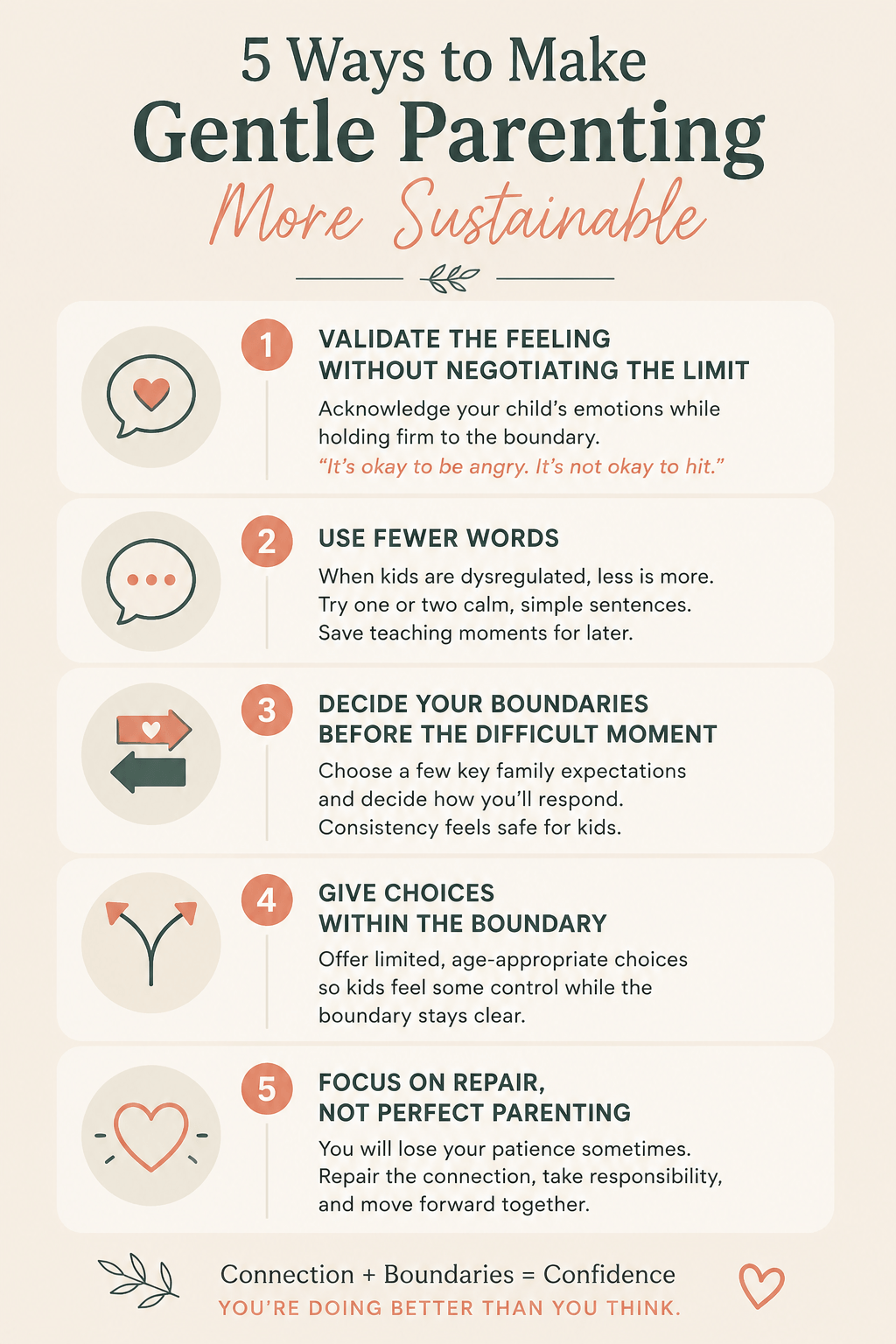
If gentle parenting currently feels exhausting, you may not need to try harder. You may need a more realistic framework.
1. Validate the Feeling Without Negotiating the Limit
Try separating emotion from behavior. In gentle parenting, misbehavior is often a signal of unmet needs or lagging skills, so proper guidance helps children respond in a healthy manner.
"It's okay to be angry. Let's look beneath the hitting for the root cause, and it's still not okay to hit."
"You really wanted another show. We're still done with screens for tonight."
"You don't want to leave. I'll help you get your shoes on."
You don't need to convince your child to agree with the boundary before enforcing it.
2. Use Fewer Words
When children are dysregulated, clear and simple communication tends to produce better behavioral outcomes than long explanations, which can add more stimulation rather than helping.
Instead of delivering a five-minute lesson during a tantrum, try one or two calm sentences. Save teaching and problem-solving for later, when your child's brain is available for them, since too little guidance or inconsistent limits can contribute to behavioral problems over time.
A useful question is: Can I say this in half as many words?
3. Decide Your Boundaries Before the Difficult Moment
Consistency becomes harder when you're making decisions while frustrated.
Choose a few family expectations that matter most and decide in advance how you'll respond. Regular routines can reduce anxiety and behavior issues, which makes clear boundaries easier to hold. This might include rules around hitting, screens, bedtime, or leaving the house.
When the boundary is already clear in your own mind, you're less likely to negotiate it because your child becomes upset.
4. Give Choices Within the Boundary
Appropriate choices can give children a sense of autonomy while promoting emotional growth and cooperation without handing over adult responsibility.
Instead of, "Are you ready to go to bed?" when bedtime isn't optional, try:
"It's bedtime. Do you want to brush your teeth or put your pajamas on first?"
The adult determines what needs to happen. The child gets practice making their own decisions, which is one way of encouraging independence and raising confident kids. The child gets some control over how it happens, and in gentle parenting this respectful structure helps children form secure attachments and supports secure attachment between parents and children.
5. Focus on Repair, Not Perfect Parenting
One difficult morning doesn't undo your relationship with your child.
When you respond in a way you regret, repair it. Take responsibility without making your child responsible for your feelings, reconnect, and think about what you might need next time.
This also models an important lesson: healthy relationships can survive conflict.
Your Child Doesn't Need You to Be Gentle Every Second
Sometimes the way gentle parenting is portrayed online makes parents feel as though every difficult behavior requires the perfect script, endless patience, and a completely regulated nervous system, even though most parents are trying to do this without formal training in child psychology while raising children.
Real families don't work that way.
Children need parents who are warm and responsive, but they also need parents who can confidently lead. They need boundaries that don't disappear when they're angry, adults who aren't afraid of their emotions, and opportunities to experience frustration while knowing they're still safe and loved.
You can be compassionate and firm. You can validate an emotion and say no. You can have a difficult interaction and come back to repair it later.
Those things aren't failures of gentle parenting. They may be what makes it sustainable.
When Parenting Starts to Feel Overwhelming
Sometimes knowing what you should do isn't the problem. You understand the parenting strategies, but something about your child's behavior continues to trigger anxiety, anger, guilt, or overwhelm.
That's where parenting support can be especially valuable.
At Creekside Counseling in Eden Prairie, Minnesota, our therapists work with parents, children, and families to understand what's happening beneath challenging behavior and build strategies that fit the actual family—not an idealized version of parenting from social media. We also recognize that family dynamics vary, and some families, including single-parent households, may be managing more challenges on average.
Parenting sessions can also provide a space separate from your child's individual therapy to talk honestly about what's happening at home, identify patterns, strengthen communication between caregivers, and develop boundaries that feel both compassionate and sustainable for parents and children.
If you're struggling to find the balance between connection and limits, you don't have to become a perfectly gentle parent. The goal is a relationship where both you and your child have room to learn, regulate, repair, and grow, and where stronger parental support can improve emotional, behavioral, and academic outcomes.

About the Author
Elisabeth Emmerich, MSW, LICSW, is the owner and founder of Creekside Counseling, where she helps children, parents, and adults build healthier relationships with themselves and those they love. As a mom of three, she understands firsthand the challenges of balancing family life, mental health, and the pressures of everyday life, bringing both professional expertise and personal understanding to her work.