

Types of Parenting Styles: The Most Common and How They Impact Your Child

If you've ever wondered whether you're being too strict, too lenient, or somehow getting the whole parenting thing wrong, you're in good company. Parenting requires us to make dozens of decisions every day, often while we're tired, stressed, or trying to respond to a child whose needs are changing just as quickly as we figure them out.
Psychologists have identified several broad types of parenting styles that describe common patterns in how parents respond to their children and set expectations. The four most commonly discussed are authoritative parenting, authoritarian parenting, permissive parenting, and uninvolved parenting.
These categories can be useful for understanding parenting styles and child development, but they're not labels meant to define whether someone is a "good" or "bad" parent. Most of us don't fit perfectly into one category. You may be authoritative most of the time but become more authoritarian when you're stressed, or find yourself becoming permissive around a particular issue because you're exhausted from arguing about it.
Your parenting may also look different with a toddler than it does with a teenager—and that's appropriate. Children need different kinds of guidance, independence, and support as they grow.
Let's look at what each parenting style can look like in everyday family life and how it may influence children's emotional and social development.
What Are the Four Main Types of Parenting Styles?
Parenting styles are generally described according to two important dimensions: how responsive a parent is to their child's emotional needs and how much structure, expectations, and guidance the parent provides.
Thinking about parenting through those two lenses can make the four styles easier to understand:
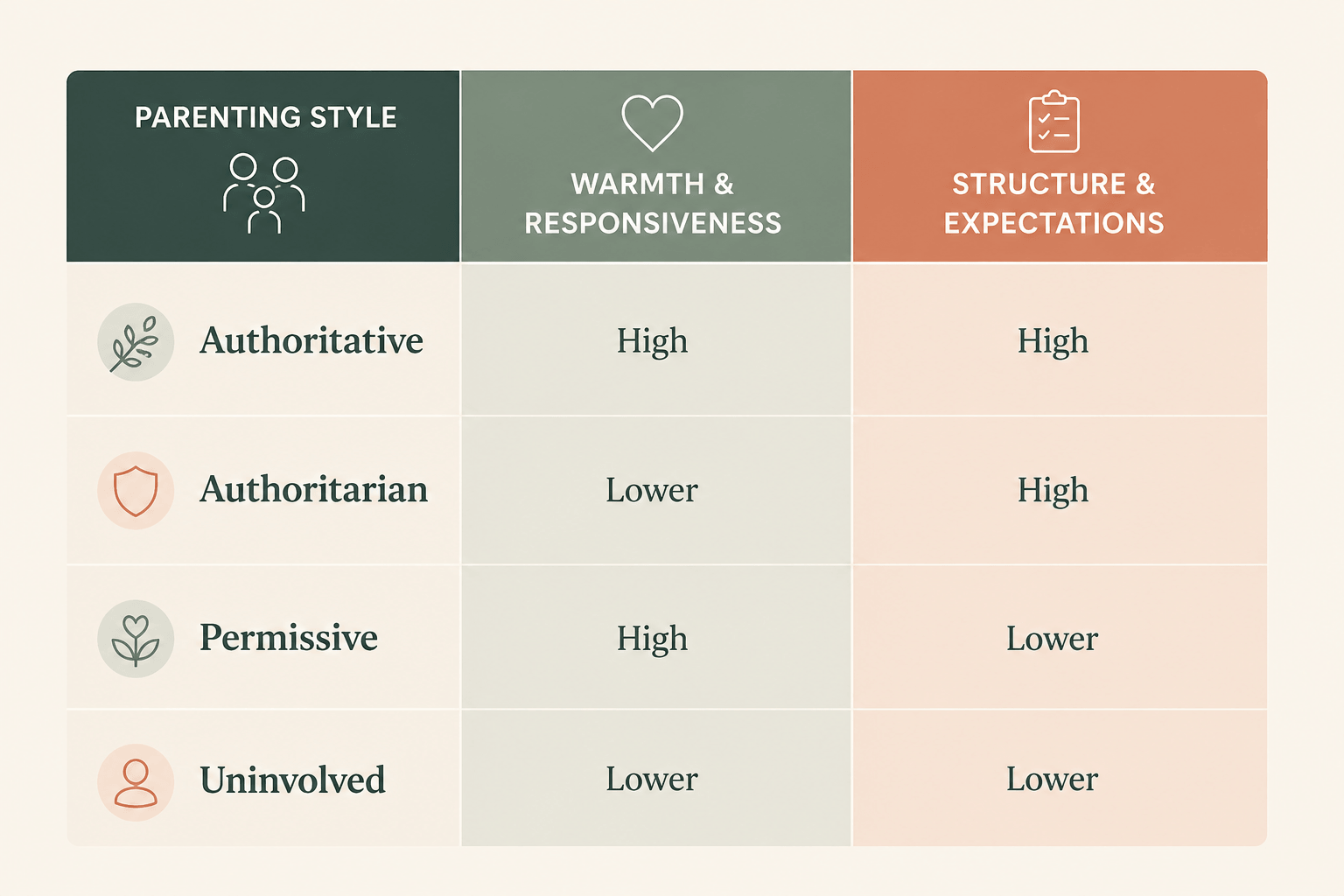
Importantly, these aren't permanent personality types. Parenting exists on a spectrum, and families often move between approaches depending on the situation, the child's temperament, cultural and family values, available support, and what else is happening in their lives.
1. Authoritative Parenting: Connection With Clear Boundaries
Authoritative parenting, one of the four main types of parenting styles, combines emotional warmth and responsiveness with clear expectations and consistent boundaries. Authoritative parents take their child's thoughts and emotions seriously while remaining comfortable in their role as the adult, and parents set clear expectations while explaining limits in age-appropriate ways.
In other words, children get a voice, but they don't always get the final decision. This style balances warmth and structure; unlike permissive parents, authoritarian parents tend to rely more on strict rules, and emotional support varies across styles.
Imagine a seven-year-old who wants to keep playing a video game after screen time is over. An authoritative parent might say:
"I know you're disappointed because you wanted to finish that level. Screen time is still finished for tonight. You can save your game, and we'll play again tomorrow."
The child's disappointment is acknowledged without changing the limit, while encouraging independence in a supportive way.
How Authoritative Parenting Can Impact Child Development
Authoritative parenting is generally associated with positive social and emotional development because authoritative parents tend to set clear expectations while staying warm and responsive, building a nurturing relationship and a strong parent child relationship that supports emotional well being and mental health. Over time, this approach can support self regulation, self esteem, higher self esteem, confidence, independence, problem-solving, and healthy relationships with adults and peers.
Children also learn that uncomfortable emotions don't have to be avoided. They can be angry about a boundary while still being expected to follow it, which gives children a voice while, unlike permissive parents, maintaining limits and encouraging independence within boundaries.
What Authoritative Parenting Looks Like at Different Ages
With toddlers, authoritative parents tend to support a stronger parent-child relationship and a nurturing relationship through warmth plus structure, which matters a lot in early childhood. With a young child, this might mean setting a physical boundary while acknowledging the emotion: "You're mad that we have to leave. I won't let you hit me. I'll help you get into the car." A toddler doesn't need a lengthy explanation; they need calm, consistent leadership.
With school-age children, there is more room for conversation, problem-solving, and age-appropriate choices. Parents can begin involving children in routines and consequences while still providing the overall structure, helping children understand expectations and reasons behind rules. In preschool age children and older kids, this style is linked to more confidence and independence, stronger self-regulation, higher self-esteem, better emotional well-being, and better mental health outcomes. Children of authoritative parents also often do better in school and show stronger academic performance.
With teenagers, authoritative parenting often becomes more collaborative. A parent might negotiate a reasonable curfew, listen to the teenager's perspective, and gradually increase independence as the teen demonstrates responsibility, which can build self confidence alongside better emotional regulation.
The balance changes with age, but the basic message remains: Your feelings and perspective matter, and I'm still here to provide guidance.
2. Authoritarian Parenting: High Expectations and Firm Control
Authoritarian parenting emphasizes rules, obedience, and adult authority. Expectations are typically clear and firm, with less negotiation or discussion about the child's perspective. Compared with more responsive approaches, authoritarian parents often rely on strict rules and less emotional support.
You may recognize phrases like:
"Because I said so."
"You know the rules."
"I'm the parent. You're the child."
Imagine the same seven-year-old refusing to turn off their video game. An authoritarian response might be:
"I told you screen time is over. Turn it off now or you lose it for the rest of the week."
The primary goal is compliance with the rule rather than understanding or processing the child's feelings about it. In practice, parents typically expect obedience without much back-and-forth.
How Authoritarian Parenting Can Impact Child Development
Clear expectations can provide children with predictability, and some families place a strong cultural or personal value on respect for authority and family hierarchy. Authoritarian parents typically emphasize obedience through strict rules and control. However, when parenting relies heavily on control without enough emotional responsiveness, children may have fewer opportunities to practice identifying emotions, making decisions, or solving problems collaboratively, which can affect child outcomes.
Some children become highly compliant, particularly around adults. Others may respond to strict control with secrecy, anxiety, anger, or increased conflict as they seek more independence. With less negotiation, there is often less emotional support or explanation, and children tend to be more rule-focused while also being at greater risk of low self-esteem.
That doesn't mean a firm parent is automatically authoritarian. Children need limits. The distinction is often found in how those limits are communicated and whether there is room for the child's emotional experience.
How It Can Change With Age
An authoritarian approach may appear effective during the toddler and early elementary years because parents have significant control over a child's environment.
The challenges can become more noticeable during adolescence. Teenagers naturally seek greater independence, develop stronger opinions, and spend more time outside their parents' direct supervision. Rules that rely primarily on obedience may create more power struggles when teens begin questioning them.
At this stage, shifting toward conversation—"Here's why this boundary matters. Tell me what you think."—can allow parents to maintain important limits while helping teenagers develop judgment of their own.
3. Permissive Parenting: Lots of Warmth With Fewer Limits
Permissive parenting is characterized by high warmth and responsiveness but fewer consistent boundaries or expectations. Permissive parents are often deeply loving and emotionally available. They may struggle, however, with holding limits when those limits cause their child distress.
Imagine that our seven-year-old protests when screen time ends.
A permissive response might sound like:
"Okay, you can have another 20 minutes, but then we really need to turn it off."
If the child becomes upset again 20 minutes later, the limit may shift again.
This often isn't because the parent doesn't care about boundaries. Sometimes parents become permissive because conflict is deeply uncomfortable, they were raised in an extremely strict household and want something different for their children, or they're simply depleted and don't have the energy for another battle.
How Permissive Parenting Can Impact Child Development
Children raised with a great deal of warmth often know their feelings matter. In this style tend to be high in warmth but low in rules, with few expectations for behavior or maturity. But without enough predictable structure, some children may have more difficulty tolerating frustration, accepting limits, developing self control, or helping children understand expectations outside the home; they may also struggle with self regulation, and that can affect behavior, social development, and academic achievement.
The goal isn't to become less loving. It's to pair that warmth with enough structure that children have opportunities to practice handling disappointment safely.
How It Can Change With Age
With toddlers, permissiveness might look like repeatedly changing a limit to stop a tantrum. The child can unintentionally learn that escalating long enough sometimes changes the answer.
With school-age children, it may show up as inconsistent rules around homework, bedtime, chores, or technology.
With teenagers, the stakes can become more significant. Teens need increasing independence, but they still benefit from expectations around safety, school, technology, relationships, and family responsibilities. Healthy autonomy isn't the absence of boundaries; it's gradually giving teenagers more responsibility within developmentally appropriate ones.
4. Uninvolved Parenting: Low Responsiveness and Low Structure
Uninvolved parenting describes a pattern in which children receive relatively little emotional responsiveness or consistent guidance.
It's especially important to discuss this parenting style without judgment because what appears to be disengagement can have many causes. A parent may be coping with depression, trauma, chronic stress, financial strain, illness, relationship difficulties, demanding work schedules, or a lack of support themselves.
Sometimes a parent isn't intentionally choosing to be uninvolved. They may simply have very little left to give.
An uninvolved response to our screen-time example might involve no consistent screen-time expectation at all. The child largely decides when and how long to play because the parent isn't regularly monitoring or engaging with the situation.
How Uninvolved Parenting Can Impact Child Development
Children need both emotional connection and dependable caregiving. When either is consistently unavailable, children may have more difficulty developing emotional regulation, trust, confidence, boundaries, or a sense of security, and low parental support can affect a child's well-being and overall growth.
The way this appears can vary considerably. Children of uninvolved parents may become extremely independent because they learn not to expect help, while another child may seek reassurance or connection intensely. Over time, some also develop low self esteem, face academic challenges, or struggle with mental health problems.
For teenagers, uninvolved parenting can sometimes be mistaken for independence. Adolescents absolutely need privacy and autonomy, but they still need adults who know what's happening in their lives, notice when something changes, and provide limits when safety is involved.
Increasing connection doesn't have to mean suddenly becoming involved in every detail. Small, consistent moments—eating together, asking about something important to your child, creating one predictable family routine—can be meaningful places to start.
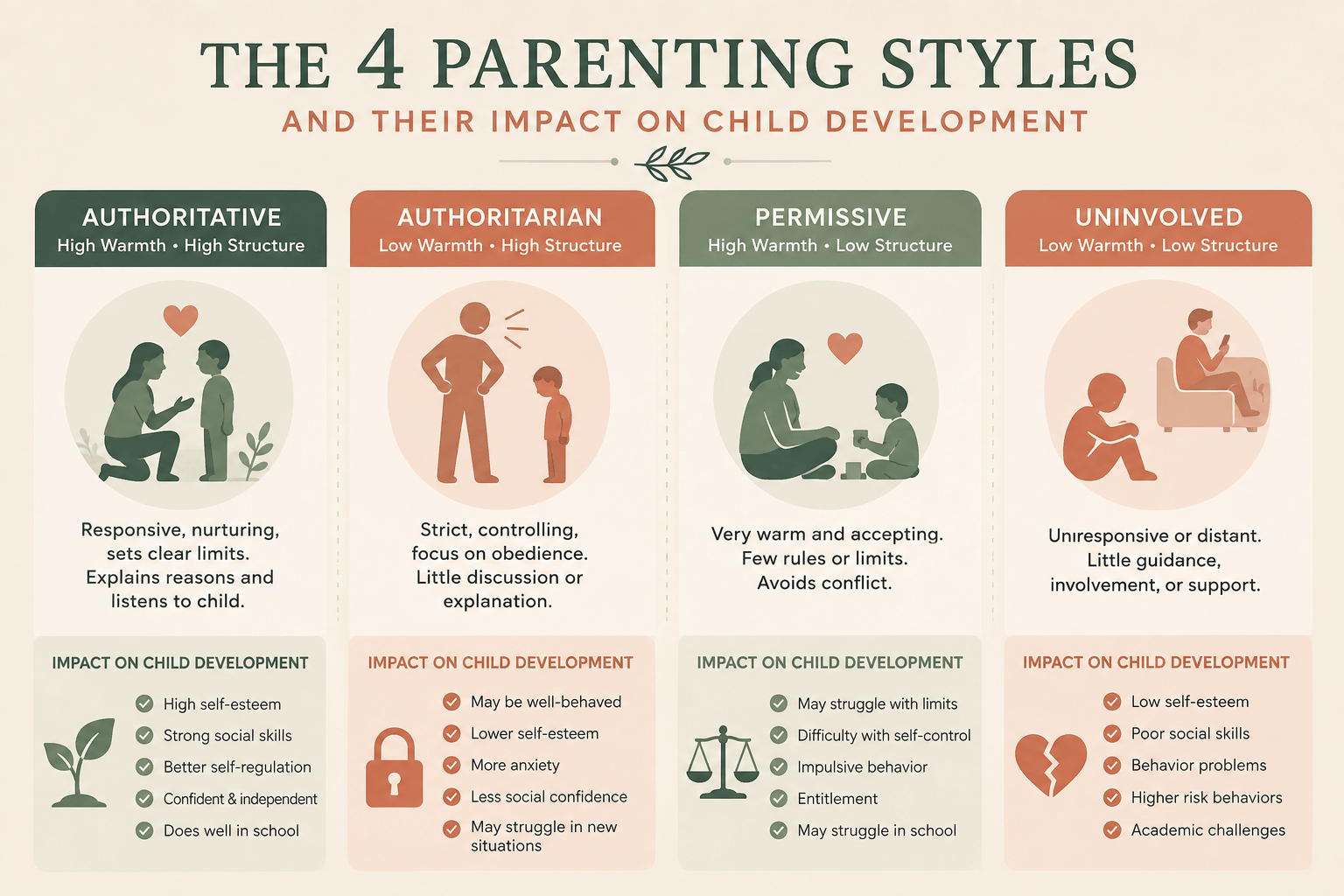
Which Is One of the Healthiest Parenting Styles?
If you're researching types of parenting styles, you'll often see authoritative parenting described as the preferred or healthiest approach. Research has generally associated authoritative parenting with positive developmental outcomes because it supports a child's development with emotional responsiveness and appropriate structure, while uninvolved parenting can leave children struggling with emotional regulation and other aspects of mental health.
But there is important nuance here.
Children have different temperaments, developmental needs, neurotypes, and life experiences. Culture and family values also influence what healthy parenting looks like. A strategy that works beautifully with one child may need to be adapted for another, and findings in J Child Fam Stud also reflect how family environment shapes outcomes.
Your approach also needs to evolve.
A two-year-old needs you to make most decisions. A ten-year-old needs opportunities to practice making them. A sixteen-year-old needs considerably more independence while still knowing there is an adult paying attention, since limited monitoring and support can contribute to poor academic performance and weaker academic achievement.
The goal isn't to identify the "perfect" parenting style and execute it correctly for the next 18 years. It's to remain responsive enough to recognize when your child—and your relationship—needs something different, because one child may become extremely independent while another may develop low self-esteem or need more help building emotional skills.
Why Parents Often Move Between Parenting Styles
You might recognize yourself in more than one section of this article.
That's normal.
A parent might calmly validate feelings and hold boundaries all afternoon, then become authoritarian at bedtime because they're exhausted. Someone who usually maintains clear expectations may become permissive around food because meals have become a source of constant conflict.
Our own childhood experiences can influence these shifts, too. If you grew up with very strict parents, you might be determined not to recreate that environment and unintentionally move too far toward permissiveness. If your childhood felt chaotic or unpredictable, maintaining control may feel particularly important to you as a parent.
Stress matters as well. It's much easier to parent intentionally when you're rested, supported, and regulated than when you're carrying work stress, financial pressure, relationship conflict, or the mental load of managing a family.
Rather than asking, "Which parenting style am I?" it can be more useful to ask:
What tends to happen to my parenting when I'm stressed?
Which behaviors are hardest for me to respond to calmly?
Do I struggle more with setting boundaries or maintaining connection?
Does my child know what to expect from me?
Am I giving my child enough independence for their age?
Do I feel like the parent I want to be most of the time?
Those questions create room for curiosity instead of judgment.
What If Your Parenting Style Doesn't Feel Like You?
Sometimes parents know they're responding in ways that don't align with their values, but they can't seem to change the pattern.
You may think, I don't want to yell, and then hear yourself yelling again. You may set a boundary and immediately give in because your child's distress feels unbearable. Or you may find yourself emotionally shutting down during conflict even though you desperately want to connect.
Knowing the "right" parenting strategy isn't always enough because parenting doesn't happen in a vacuum. Your own nervous system, childhood experiences, relationships, stress level, and beliefs about conflict can all show up in interactions with your child.
This is where therapy can be helpful—not because you've chosen the "wrong" parenting style, but because you want your actions to feel more aligned with the parent you want to be.
Finding a Parenting Approach That Fits Your Family
Parenting styles give us a useful framework, but they aren't a scorecard.
Families vary widely, and beyond the classic framework discussed by developmental psychologist Diana Baumrind, you may also hear terms like helicopter parenting, free range parenting, or free range parents in sources such as Child Fam Stud and Environ Res Public Health.
You don't need to read this article and decide that you're an authoritarian parent, a permissive parent, or even a perfectly authoritative one. Most parents are doing the best they can with the tools, experiences, and capacity they have at that particular moment.
What matters is the ability to notice patterns and make adjustments.
If your current approach leaves you feeling disconnected from your child, stuck in constant power struggles, unsure how to set boundaries, or simply unlike yourself, therapy can give you a place to explore what's happening without judgment.
At Creekside Counseling in Eden Prairie, Minnesota, our therapists work with parents and families throughout the Twin Cities to understand how their own experiences influence parenting, strengthen parent-child relationships, and develop practical strategies that fit their child's developmental needs.
You don't have to become a completely different kind of parent. Sometimes the work is simply closing the gap between how you're parenting now and how you want parenting to feel.

About the Author
Elisabeth Emmerich, MSW, LICSW, is the owner and founder of Creekside Counseling, where she helps children, parents, and adults build healthier relationships with themselves and those they love. As a mom of three, she understands firsthand the challenges of balancing family life, mental health, and the pressures of everyday life, bringing both professional expertise and personal understanding to her work.