

What Are Social Skills? A Child Therapist Explains Why They Matter More Than You Think
As child therapists, one of the most common concerns we hear from parents is: “My child struggles socially. Is this normal?”
Maybe your child has difficulty making friends. Maybe they interrupt conversations, avoid group settings, become overwhelmed during playdates, or struggle to read social cues. Some children appear shy and anxious, while others may come across as impulsive, rigid, or emotionally reactive around peers.
These situations can leave parents feeling worried, confused, or unsure how to help.
The good news? Social skills are not something children either “have” or “don’t have.” They are skills that develop over time with support, modeling, practice, and experience. In fact, social skills often begin to emerge at an early age, making it important to support their development from a young age.
Let’s take a closer look at what social skills actually are, why some children struggle with them, and how parents can support their child’s growth.
What Are Social Skills?
Social skills are the tools we use to interact, communicate, and build relationships with others. They help children navigate everyday situations at home, school, extracurricular activities, and friendships (source).
Social skills include both verbal and nonverbal communication and involve understanding how our behavior impacts other people. The five components of social skills—social awareness, social cognition, social communication, social motivation, and autistic mannerisms—are key elements for effective interpersonal interactions and understanding social behavior.
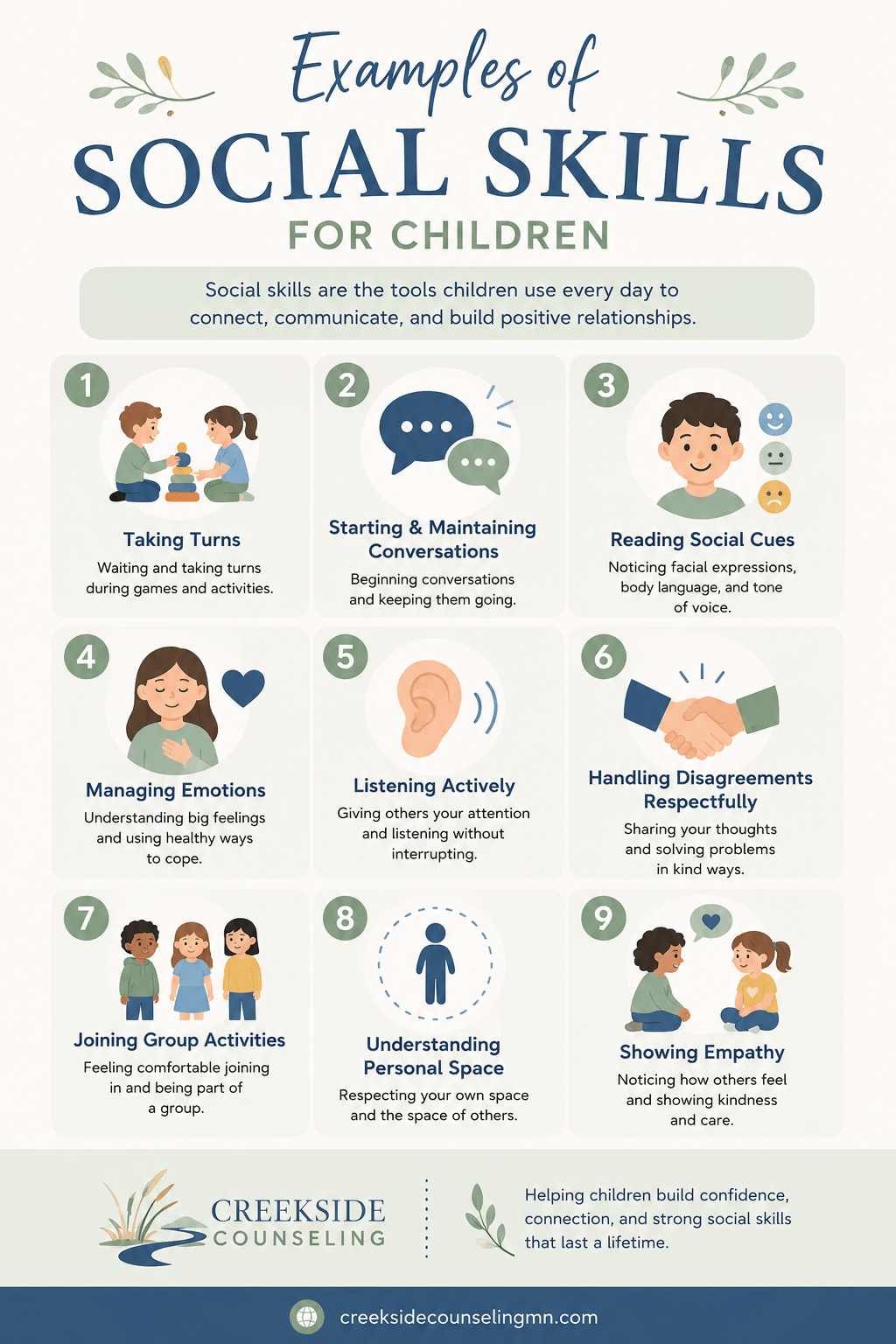
Some of the most important social skills include effective communication, conflict resolution, active listening, empathy, relationship management, and respect.
For children, social skills examples may include:
Taking turns during play
Starting or maintaining conversations
Reading facial expressions and body language
Managing frustration appropriately
Listening when others are speaking
Handling disagreements respectfully
Joining a group activity
Understanding personal space
Showing empathy toward peers
These skills play a major role in helping children feel confident, connected, and successful socially.
Foundations of Social Skills
Social skills form the bedrock of every strong relationship, whether at home, school, or later in the workplace. At their core, these skills are about how we connect, communicate, and collaborate with others. Developing strong interpersonal skills—like active listening, emotional intelligence, and effective communication—gives children the tools they need to thrive in all areas of life.
Interpersonal skills, sometimes called soft skills, go beyond just talking. They include understanding body language, reading facial expressions, and knowing when to listen or speak up. These abilities help children navigate social situations, build positive relationships, and manage relationships with empathy and respect. When children practice these skills, they learn how to communicate effectively, resolve misunderstandings, and create healthy relationships that last.
By encouraging children to develop these foundational skills early on, parents set them up for success—not just in friendships, but in every personal and professional relationship they’ll build throughout their lives. The ability to communicate, understand others, and respond thoughtfully is a lifelong asset that supports well-being and strong connections.
Why Do Some Children Struggle Socially?
Children develop social skills at different rates, and there are many reasons why social situations may feel difficult for a child.
Some children naturally feel more anxious or reserved in groups. Others may struggle with flexibility, impulse control, emotional regulation, or communication. Difficulties with social cognition—the ability to process and interpret social cues—can also contribute to social struggles. Social difficulties are also common among children with ADHD, autism, anxiety, sensory sensitivities, or learning differences.
In therapy, parents often describe concerns like:
“My child doesn’t know how to join in with other kids.”
“They get overwhelmed during playdates.”
“They struggle when things don’t go their way.”
“Other kids seem frustrated with them.”
“They want friends, but don’t know how to connect.”
It’s important to remember that these challenges are not a reflection of bad parenting or a child being “difficult.” Often, children simply need more support learning the hidden social rules that come naturally to others.
Interpersonal Skills vs Social Skills: What’s the Difference?
Parents sometimes hear the terms interpersonal skills and social skills used interchangeably, but there are subtle differences between the two.
Social skills refer to the specific behaviors children use in social interactions, such as taking turns, making eye contact, or recognizing emotions.
Interpersonal skills are broader and involve how we build and maintain relationships over time. They include communication, empathy, emotional awareness, conflict resolution, and cooperation. These skills are essential for developing strong interpersonal relationships, both personally and professionally.
In simple terms:
Social skills help children navigate social situations.
Interpersonal skills help children build meaningful relationships.
Both social and interpersonal skills are important for emotional development and for building strong relationships, including professional relationships, which contribute to long-term confidence.
Why Social Skills Matter for Children
Strong social skills impact far more than friendships.
Children who feel confident socially are often better able to:
Manage emotions
Handle conflict
Work collaboratively in school settings
Advocate for themselves
Build self-esteem
Develop resilience
These skills are also closely linked to future job performance and success in personal and professional relationships, contributing to career advancement and overall happiness.
On the other hand, ongoing social struggles can affect a child’s confidence and emotional well-being. Some children begin avoiding social situations altogether, while others may act out due to frustration or difficulty regulating emotions.
As therapists, we often see that social challenges are deeply connected to emotional regulation. A child who struggles socially is not simply “misbehaving.” They may be overwhelmed, anxious, impulsive, or unsure how to navigate a situation successfully.
Common Social Skills Challenges Parents Notice
Many social difficulties are subtle at first. Sometimes parents notice their child consistently struggling in situations that seem to come easily to peers.
Some common concerns include:
Difficulty making or keeping friends
Interrupting conversations frequently
Becoming upset when losing games or taking turns
Trouble understanding jokes, sarcasm, or tone
Avoiding eye contact or group interactions
Difficulty with flexibility during play
Emotional meltdowns after social situations
Trouble respecting personal boundaries or space
Difficulty reading body language or facial expressions, or understanding nonverbal cues such as gestures, posture, and tone of voice
For younger children, parents may notice frequent conflict during playdates or challenges participating in group activities. Older children may begin withdrawing socially or expressing worries about fitting in.
Conflict Resolution for Kids
Learning how to resolve conflicts is a critical part of growing up and building strong interpersonal skills. For kids, disagreements with friends or siblings are a normal part of social development, but knowing how to handle them in a positive way makes all the difference. Conflict resolution skills—like active listening, empathy, and problem-solving—help children communicate effectively and maintain healthy relationships.
Teaching kids to practice active listening means encouraging them to really hear what others are saying, rather than just waiting for their turn to speak. Using “I” statements (“I feel upset when…”) helps children express their feelings without blaming others, while respecting personal space shows consideration for others’ boundaries. These simple strategies foster a positive attitude and help kids manage relationships with kindness and respect.
By guiding children through the steps of resolving conflicts—listening, expressing feelings, finding solutions together—parents help them build confidence and resilience. These skills not only strengthen friendships but also prepare children for future challenges in school, the workplace, and beyond. The ability to solve problems and communicate respectfully is a lifelong gift that supports positive relationships in every setting.
Overcoming Social Anxiety in Children
Social anxiety can make everyday interactions feel overwhelming for children, but with the right support, they can learn to navigate social situations with confidence. Overcoming social anxiety starts with teaching essential social skills, such as active listening, making eye contact, and using clear verbal skills. These abilities help children feel more comfortable and capable when interacting with peers.
Building strong interpersonal skills—like empathy, communication skills, and self-awareness—empowers children to connect with others and build positive relationships. Practicing social interactions, such as small talk or asking personal questions in a safe environment, helps children gain confidence and develop new skills. Encouraging children to recognize and manage their own emotions, as well as understand nonverbal cues like body language and facial expressions, supports self-regulation and effective communication.
Parents and caregivers play a vital role by providing encouragement, modeling healthy social behaviors, and creating opportunities for practice. With patience and support, children can overcome social anxiety, develop strong relationships, and thrive in all areas of life. The journey may take time, but every step forward builds self-esteem and a sense of belonging.
Can Social Skills Be Taught?
Absolutely.
One of the biggest misconceptions parents carry is believing social skills should “just happen naturally.” While some children pick up social rules intuitively, many benefit from direct teaching, modeling, and practice.
Social skills grow through:
Repetition
Guided support
Observation
Safe opportunities to practice
Developing social competence and people skills involves ongoing practice, targeted exercises, and constructive feedback from trusted individuals to foster effective communication and relationship-building.
This is why structured support—such as therapy or social skills groups—can be so helpful.
In therapy, we often use play-based and interactive approaches to help children:
Practice conversations
Learn emotional regulation strategies
Improve flexibility
Build confidence in peer interactions
Understand social cues more clearly
Therapists offer guidance and use practical methods such as simulations, exercises, and constructive feedback to help children improve their social skills in a supportive environment.
Children learn best when skills are practiced in real-life, supportive environments rather than simply talked about.
Setting measurable goals is also important for tracking progress and ensuring continuous improvement in social skill development.
How Parents Can Support Social Skills at Home
Parents play a huge role in helping children build social confidence.
Some simple ways to support social development include:
Modeling respectful communication
Practicing turn-taking games
Talking openly about emotions
Role-playing social situations
Encouraging low-pressure peer interactions
Praising effort rather than perfection
Helping children identify areas where they want to improve their social skills
Practicing active listening is also essential—encourage your child to fully concentrate on the speaker and respond appropriately, as this builds better relationships.
It’s also important to avoid labeling children as “shy,” “awkward,” or “bad with people.” Children often internalize these messages, which can impact confidence over time.
To help your child stay focused on their social goals, provide consistent support and accountability.
Instead, focus on growth: “This is something we’re learning and practicing together.”
When Additional Support May Help
Sometimes children need more structured support to develop social confidence and flexibility.
A social skills group can be especially helpful for children who:
Feel anxious in social situations
Struggle with peer relationships
Have ADHD-related social challenges
Become emotionally overwhelmed during interactions
Need help practicing communication and emotional regulation skills
These groups give children the opportunity to learn and practice skills in a safe, supportive setting with peers who may be experiencing similar challenges. Participating in social skills groups helps children build connections with others, which is foundational for future personal, professional, and even romantic relationships. Strong social skills developed in these groups also contribute to effective teamwork, problem-solving, and communication in the workplace later in life.
Join Our Summer Social Skills Group in Eden Prairie
At Creekside Counseling, we’re excited to offer a small, therapist-led Social Skills Group for kids ages 8–10 this summer in Eden Prairie, MN.
This group incorporates elements of the Superflex® curriculum to help children:
Build flexible thinking
Improve social awareness
Manage big emotions
Strengthen friendships
Develop confidence in social situations
The group is especially supportive for children experiencing social anxiety, ADHD-related challenges, emotional regulation difficulties, or struggles with peer relationships.
With a small group size and engaging, interactive activities, children have the opportunity to practice skills in a warm and supportive environment.
If you’re wondering whether this group may be a good fit for your child, we’d love to connect.