


Senior year is supposed to feel exciting. After years of school, your teenager is finally getting to think seriously about what comes next.
But for many families, the process of going to college doesn't feel particularly exciting at first. It feels like deadlines, essays, test scores, campus visits, financial decisions, comparison, and a seemingly endless stream of questions about the future.
For some teens, college application stress is manageable. For others, college application anxiety becomes a significant source of distress during senior year—showing up as overwhelming worry, procrastination, trouble concentrating, and even physical symptoms that go beyond normal application stress.
If your teen is stressed about college applications, procrastinating on essays, obsessing over acceptance rates, or feeling like one decision will determine the rest of their life, they may need something different from another reminder about a deadline.
They may need help putting the process back into perspective.
As therapists who work with children, teens, and parents, we often encourage families to think about college applications as more than an academic process. Your teenager is also navigating a major developmental transition—one that involves independence, identity, uncertainty, relationships, and a changing role within the family.
For parents, caregivers, and families trying to support a teen through this, it helps to understand what may be driving the anxiety—academic pressure, perfectionism, and social comparison—along with how to respond at home, how to help your teen prepare emotionally for college, and when it may be time to look for professional support, including therapy resources in Eden Prairie, Minnesota.
Understanding what's happening beneath the stress can help you support your teen without unintentionally adding more pressure, protect your teenager's mental health and daily functioning, and make this transition feel more manageable for everyone.
Why Are College Applications So Stressful for Teens?
College applications involve an unusual combination of high stakes, uncertainty, deadlines, and peer comparisons.
Your teenager is being asked to summarize years of academic work, extracurricular activities, interests, and accomplishments while knowing that someone they've never met will ultimately decide whether they're admitted, and many teens feel stressed by not knowing whether they will be accepted.
At the same time, they may be hearing questions like:
"Where are you applying?"
"What's your top choice?"
"What was your ACT score?"
"Did you get into ___?"
Even well-intentioned conversations can begin to make teenagers feel as though everyone is watching.
Then add schoolwork, sports, jobs, friendships, family responsibilities, and trying to enjoy their final year of high school.
It's not surprising that high school senior stress can become overwhelming.
What Is Academic Pressure?
Academic pressure is the stress students experience when they feel significant expectations around grades, achievement, performance, or their educational future.
Some pressure can motivate students. But excessive academic pressure on students can make it difficult for teens to separate their accomplishments from their sense of worth.
A teenager may begin thinking:
If I don't get an A, I'm falling behind.
If I don't get into this school, I've failed.
Everyone else has done more than me.
My parents will be disappointed.
One bad semester is going to ruin my future.
Academic pressure can come from school, peers, social media, family expectations, or the teen themselves. Often, it's a combination.
And by senior year, years of achievement-focused thinking can collide with the uncertainty of college admissions.
College Application Anxiety vs. Normal College Application Stress
Some college admissions stress is expected.
Deadlines matter. Decisions feel important. There are genuinely a lot of moving pieces.
Stress may increase before an application deadline or while waiting for a decision and then settle afterward.
College application anxiety may feel harder for a teen to turn off.
Instead of worrying about a specific essay or deadline, anxiety may begin affecting sleep, mood, concentration, relationships, or everyday functioning, and excessive stress can increase the risk of anxiety, depression, burnout, or eating-related struggles.
You might notice your teenager:
Constantly talking or worrying about admissions
Avoiding applications because they feel overwhelming
Procrastinating despite wanting to finish
Repeatedly checking applications, essays, or portals
Seeking constant reassurance
Comparing themselves to classmates
Becoming unusually irritable or emotional
Having trouble sleeping
Complaining of headaches, stomachaches, or feeling physically tense
Losing interest in activities they normally enjoy
Believing one rejection will determine their future
Changes in mood are especially important to recognize because they can be a sign that stress is becoming too much.
College admissions anxiety can also show up in ways that don't immediately look like anxiety.
A teenager who appears unmotivated may actually feel so overwhelmed that they don't know where to begin.
When Perfectionism in Teens Makes College Applications Even Harder
College admissions can be especially difficult for teens who already struggle with perfectionism.
Perfectionism in teens isn't simply caring about doing well. A perfectionistic teenager may feel that mistakes are unacceptable or that their accomplishments determine their value.
That can make an inherently unpredictable process like college admissions particularly uncomfortable.
They can work incredibly hard and still receive a rejection.
They can write a thoughtful essay and still wonder whether it was "good enough."
They can meet every deadline and still have no control over the final outcome.
Some perfectionistic teens respond by working constantly. Others procrastinate.
That may seem contradictory, but procrastination can sometimes be a response to perfectionism. If your teen believes their essay needs to be exceptional, opening a blank document may feel much harder than it would if "good enough" felt acceptable.
Instead of saying, "You just need to get it done," try getting curious about what's making it difficult to start.
If anxiety is beginning to interfere with everyday life, therapy for anxiety can help teens develop tools for managing worry and uncertainty.
How Social Comparison Adds to College Admissions Stress
College applications don't happen in isolation.
Your teen may be surrounded by classmates discussing acceptance letters, scholarships, test scores, and dream schools. Social media adds another layer, with carefully curated college announcements and celebratory posts.
Suddenly, another student's acceptance can feel like evidence that your child is behind.
Remind your teen that they are often comparing their entire uncertain process with someone else's announcement.
They aren't seeing the rejection letters, financial considerations, family conversations, anxiety, or uncertainty behind the post.
You can celebrate someone else's good news without using it as a measurement of your own future.
How to Help My Teen With College Applications Without Taking Over
If you've searched "how to help my teen with college applications," the answer isn't to remove yourself from the process entirely.
Most teenagers still need support, and parents can deal with stress better by staying proactive in communication and organized without taking over.
The challenge is providing enough structure to encourage organization while still letting the student lead the application process, so it doesn't feel like your project.
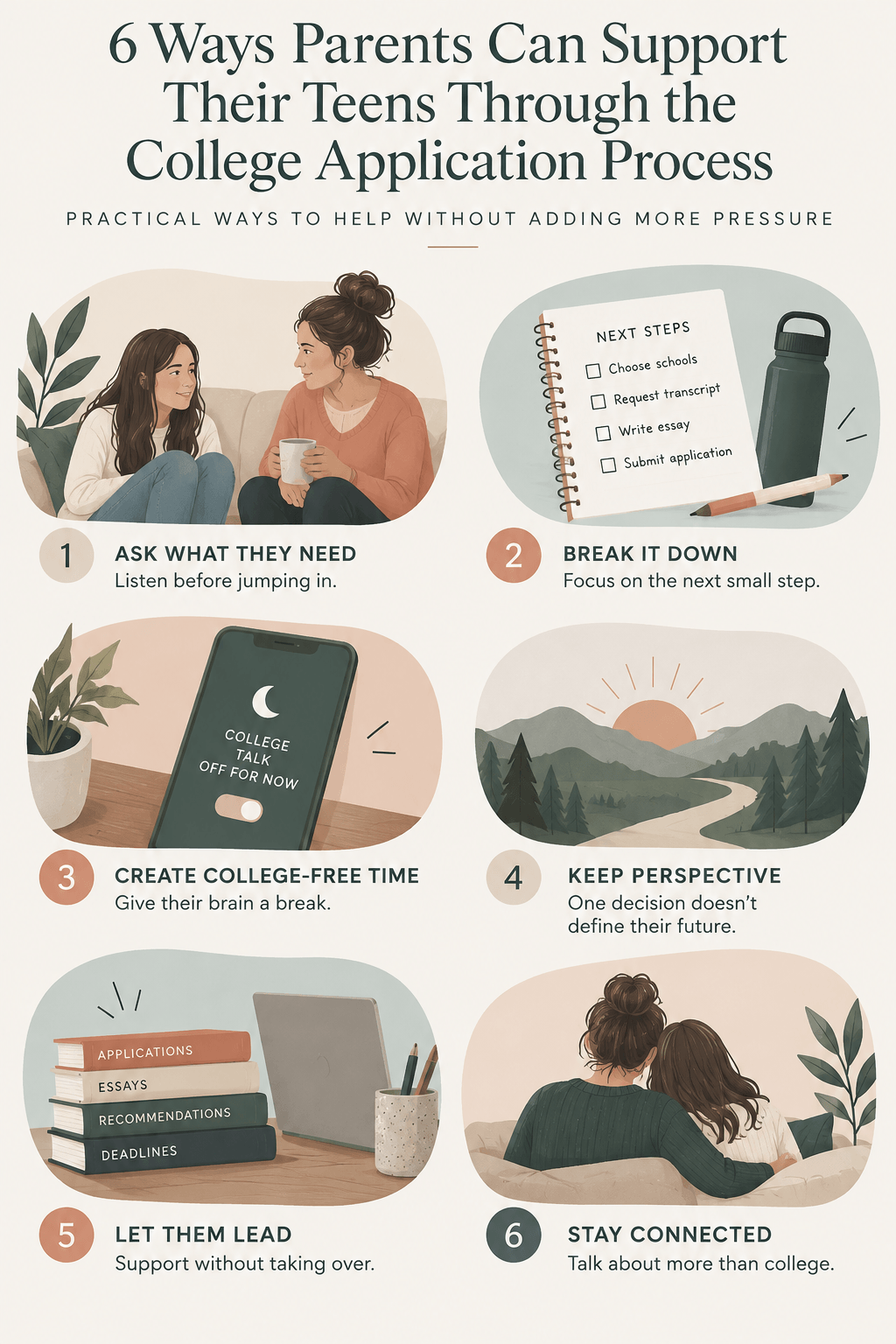
1. Ask What Kind of Help They Want
Before jumping in, ask:
"Do you want me to help you figure this out, listen while you talk it through, or give you some space?"
Listening actively can help students cope with application-related stress before you move into solutions. Teens are also more likely to open up when they feel part of a supportive community at home or school.
Your teenager may want you to proofread an essay. They may want help making a deadline calendar. Or they may simply need someone to listen while they say how overwhelmed they feel.
Don't assume every expression of stress is a request for a solution.
2. Break the Process Into Smaller Pieces
When a teenager is overwhelmed by college applications, saying, "You need to work on your applications" isn't particularly helpful.
The task is too big.
Instead, identify the next concrete step:
Make a list of application deadlines
Choose one school to work on
Create the application account
Request a transcript
Brainstorm essay topics for 20 minutes
Complete one section of the application
Ask a teacher for a recommendation
A smaller task gives an overwhelmed brain somewhere to begin.
3. Create a College-Free Zone
Not every dinner needs to become a college conversation.
Consider establishing times when applications are intentionally off-limits. Maybe your teen doesn't want to discuss admissions immediately after school or during family dinner, and protecting that application-free time helps maintain balance alongside homework and other things.
Having predictable breaks can help the process feel like one part of their life instead of their entire identity, especially when that balance includes routine breaks and fun activities.
4. Be Careful With Reassurance
When your teenager says, "I'm never going to get in," your instinct might be:
"Of course you will!"
But you can't actually promise that.
Try:
"I can tell how much this matters to you. We don't know what the decision will be yet, but I do know that one admissions decision won't determine what you're capable of."
It also doesn't define their worth as a person.
You're offering reassurance about them, not predicting an outcome you can't control.
5. Let Some Ownership Stay With Your Teen
As difficult as it can be to watch your child procrastinate, forget something, or make a decision you wouldn't make, preparing for college also means practicing independence.
Parents can help create structure without completing every task or using too much push.
Instead of:
"Did you submit the application? Did you email your counselor? Did you finish the essay?"
Try:
"What's your plan for getting everything submitted by Friday?"
The shift is subtle, but it communicates: I believe you're capable of taking increasing responsibility for this. Staying regulated yourself can make it easier for your teen to cope.
Sometimes parents need support figuring out when to step in and when to step back. Parenting support can help you find that balance.
How to Talk to Your Teen About College Without Adding More Pressure
Knowing how to talk to your teen about college can be surprisingly difficult because even supportive questions can start to feel like pressure when they're asked repeatedly. Your overall parenting style can also influence how you approach independence, expectations, and decision-making during the teen years.
Try to lead with curiosity instead of evaluation.
Instead of:
"Why haven't you finished your essay yet?"
Try:
"What's feeling hardest about the essay right now?"
Instead of:
"You should apply to more safety schools."
Try:
"For example, how are you feeling about the balance of schools on your list, including safeties, targets, and reaches?"
Instead of:
"You need to stop stressing."
Try:
"This seems like it's been taking up a lot of mental space lately."
And sometimes, don't talk about college at all.
Your child is still the same teenager who likes music, sports, friends, video games, art, baking, hiking, or watching a favorite show with you.
Continue showing interest in those parts of them too.
How to Stop Stressing About College Admissions
Parents and teens sometimes ask, "How to stop stressing about college admissions?"
Completely eliminating stress probably isn't a realistic goal.
Instead, help your teen reduce the amount of attention the admissions process gets to consume.
Encourage them to focus on what they can control:
They can control: putting thoughtful effort into an application, asking for help, meeting deadlines, researching schools, and taking care of themselves.
They cannot control: how many students apply, another student's qualifications, an admissions committee's priorities, or the final decision.
When your teen starts spiraling about an outcome, gently bring them back to:
"What's the next thing you can actually do?"
Then make room for life outside college applications.
Sleep. Eat dinner. Go to practice. See friends. Take a walk. Watch something funny.
Rest is not wasted time.
How to Help a Teenager Overwhelmed With School
Sometimes college applications aren't really the entire problem. They're simply one more thing added to a teenager who was already at capacity.
We see a similar pattern in younger kids who hold it together at school and melt down at home—sometimes home is simply where all that accumulated stress finally comes out
If you're wondering how to help a teenager overwhelmed with school, start by looking at the whole picture.
How much sleep are they getting?
How many hours are they spending on homework?
How many extracurricular commitments do they have?
Are they working a job?
Are they struggling socially?
Are they taking several advanced classes?
Do they have any time during the week when nothing is expected of them?
Sometimes the answer isn't another productivity strategy.
It may be reducing commitments, adjusting expectations, asking teachers for support, building in genuine downtime, or accepting that your teenager cannot perform at 100% in every area simultaneously.
How to Prepare Your Teenager for College Emotionally
When parents think about how to prepare your teenager for college, it's easy to focus on practical skills.
Can they do laundry?
Make an appointment?
Manage money?
Wake themselves up?
Those things matter.
But emotional preparation matters too.
The transition to college can involve excitement alongside grief, fear, loneliness, and uncertainty. Your teenager may be thrilled to leave home and terrified to leave home at exactly the same time.
Before they go, give them opportunities to practice:
Making decisions without immediately asking you
Communicating with teachers or other adults themselves
Managing a schedule
Handling disappointment
Asking for help
Recovering from mistakes
Solving manageable problems independently
Talking openly about mental health
Recognizing when stress is becoming too much
Preparing a teenager for adulthood isn't about making sure they never struggle.
It's helping them trust that they can encounter something difficult, use their resources, ask for support, and figure out what comes next.
What Parents Need to Remember During the College Application Process
Your teenager's college decision can begin to feel like a reflection of your parenting.
It isn't.
Their acceptance isn't your achievement, and their rejection isn't your failure.
Your child needs to know that the relationship they have with you isn't dependent on where they attend college—or whether college is ultimately the path they choose.
One of the most grounding things you can communicate during this process is:
"I'm excited to see where you end up, but I'm proud of who you are regardless."
That message matters.
Some students are afraid to say they're struggling; one in seven feel they have no one to talk to, and one in seven feel isolated around mental health during this process.
Safe peer support groups can reduce that isolation and help high-achieving students open up in supportive communities; even focus groups of six to eight students can create space to share stress.
Especially when the rest of the world seems very focused on the outcome.
When College Anxiety May Be a Sign Your Teen Needs More Support
Stress in teenagers isn't automatically a mental health problem. Stress is part of navigating school, relationships, growing independence, and major life transitions.
But college anxiety deserves additional attention when it begins interfering with your teenager's ability to function or enjoy everyday life.
Consider reaching out to counselors or seeking additional support if your teen:
Seems anxious or irritable most days
Is consistently struggling to sleep
Is experiencing panic attacks
Avoids school or important responsibilities
Has become socially withdrawn
Has lost interest in things they usually enjoy
Is experiencing frequent physical symptoms related to stress
Is overwhelmed by perfectionism or fear of failure
Seems hopeless about their future
Is struggling significantly with eating, mood, or self-esteem
Seeking professional help can provide support and tools for coping, and virtual mental health support may also be an option.
And if your teenager talks about self-harm, suicide, or not wanting to be alive, take those statements seriously and seek immediate professional support. In the U.S., you can call or text 988 for crisis support.
Teen Therapy and Parenting Support in Eden Prairie, Minnesota
College applications may be temporary, but the emotions they bring to the surface can tell us something important.
For some teenagers, this season reveals anxiety that has been quietly building for years. For others, perfectionism, academic pressure, family expectations, uncertainty about the future, or other challenges suddenly become harder to manage.
Therapy can give teenagers a space outside of school and family to talk honestly about what they're experiencing, learn strategies for managing anxiety and stress, build confidence as they move toward greater independence, and, for some families, manage stress tied to admissions and financial aid decisions.
At Creekside Counseling in Eden Prairie, Minnesota, we offer therapy for teens and young adults navigating anxiety, stress, perfectionism, trauma, family relationships, and major life transitions. We also offer parenting support for parents who want help staying connected while giving their teenager the independence they increasingly need.
And parents can benefit from support, too. You don't have to choose between being involved and stepping back completely. Sometimes the work is learning how to stay connected while allowing your teenager to increasingly take the lead, and recognizing that seeking advice and support when the process feels overwhelming is a strength.
FAQ: College Application Stress and Teen Anxiety
Is it normal for teens to have anxiety about college applications?
Yes. Some college application anxiety is understandable because teenagers are navigating deadlines, uncertainty, academic expectations, and decisions about their future all at once. It may be time to seek additional support when anxiety begins interfering with your teen’s sleep, mood, relationships, school performance, or ability to complete everyday tasks.
How can I help my teen who is stressed about college applications?
Start by asking what kind of support your teen actually wants. They may need help breaking applications into smaller tasks, organizing deadlines, or proofreading an essay—or they may simply need you to listen. Creating college-free time at home can also help remind your teenager that applications are only one part of their life.
How do you stop stressing about college admissions?
It may not be realistic to eliminate college admissions stress completely. Instead, encourage your teen to separate what they can control—such as completing applications thoughtfully and meeting deadlines—from what they can't control, including admissions decisions and other applicants. Regular sleep, downtime, movement, friendships, and activities unrelated to college can also help keep the process in perspective.
What should I do if my teenager is overwhelmed by college applications?
If your teenager is overwhelmed by college applications, make the next task smaller. Rather than telling them to “work on applications,” choose one concrete step, such as creating an application account, requesting a transcript, or brainstorming essay ideas for 20 minutes. If overwhelm is affecting multiple areas of their life, consider whether anxiety, perfectionism, or broader academic stress may also be contributing.
How can parents help with college applications without taking over?
Think of your role as providing structure and support rather than managing the process for your teenager. You can help create a timeline, answer questions, and offer reminders while allowing your teen to increasingly communicate with schools, manage deadlines, and make decisions themselves. These are valuable skills they'll need when going to college.
How can I talk to my teen about college without adding pressure?
Lead with curiosity rather than evaluation. Instead of repeatedly asking whether an application is finished, try asking, “What part feels hardest right now?” Also make sure college isn't the only thing you're talking about. Your teenager needs to know you're interested in who they are—not only where they get accepted.
When does college application stress become anxiety?
Stress tends to be connected to a particular challenge and often decreases once that challenge passes. College admissions anxiety may be more persistent and can affect sleep, concentration, mood, physical symptoms, relationships, or everyday functioning. If your teen seems unable to disengage from worry or their anxiety is interfering with daily life, talking with a mental health professional may be helpful.
Can academic pressure affect a teenager's mental health?
Yes. When academic pressure becomes intense or prolonged, teenagers may experience anxiety, irritability, sleep difficulties, burnout, perfectionism, or feelings that their worth depends on their performance. Helping teens develop an identity and sense of self-worth outside of grades and college admissions can be an important protective factor.

About the Author
Elisabeth Emmerich, MSW, LICSW, is the owner and founder of Creekside Counseling, where she helps children, parents, and adults build healthier relationships with themselves and those they love. As a mom of three, she understands firsthand the challenges of balancing family life, mental health, and the pressures of everyday life, bringing both professional expertise and personal understanding to her work.