

You've worked hard to create a loving, stable home for your child. Yet adopted child emotional problems can still show up as intense anger, anxiety, grief, confusion about identity, and emotional outbursts—even when a child is deeply loved, safe, and well cared for. When that happens, it can leave adoptive parents and caregivers feeling confused by behaviors they don't understand.
You might wonder, Why is my adopted child so angry? Are we doing something wrong? Why are they struggling when they're surrounded by so much love?
These are understandable questions, and they don't mean you've failed as a parent.
The truth is that adoption can involve complicated emotional experiences that love alone does not erase. Feelings of grief, uncertainty, loss, and confusion about identity or belonging don't automatically disappear because a child is in a supportive environment. Understanding what may be driving your child's anger, anxiety, or emotional shutdown is an important part of helping them feel safe, connected, and understood.
At Creekside Counseling in Eden Prairie, Minnesota, we help families make sense of these patterns. In this article, you'll learn how adoption can affect emotional development, why some adopted children struggle with anger and anxiety, how identity and belonging issues can shape behavior, what can help with emotional regulation at home, and when therapy may be the right next step.
How Adoption Trauma Can Affect a Child's Emotional Development
Every adoption story is different. Some children were adopted as infants, while others experienced multiple caregivers, foster care, or significant transitions before joining their adoptive families. Some maintain relationships with their birth families, while others have limited information about their origins.
These experiences can shape how children understand themselves, their relationships, and the world around them.
Importantly, adoption itself isn't a mental health diagnosis, and not every adopted child experiences emotional or behavioral difficulties.
However, some children may navigate additional layers of grief, identity development, uncertainty, or relationship challenges that deserve acknowledgment.
Grief and Loss Can Exist Alongside Love
One of the most important things for adoptive parents to understand is that love and grief aren't mutually exclusive.
A child can feel deeply connected to their adoptive family while also grieving relationships, experiences, or information they don't have.
Depending on their circumstances, children may experience grief related to:
Separation from birth parents or other important caregivers
Limited knowledge about their family history
Loss of connections to their culture, language, or community
Questions about why they were adopted
Missing relationships with biological siblings or relatives
Feeling different from peers or other family members
Sometimes children can explain these feelings clearly. Other times, particularly when they're younger, those emotions may emerge through behavior.
A child who becomes upset during a family-tree assignment at school, for example, may be experiencing something much more complicated than frustration with homework.
Rather than immediately trying to make the feeling go away, parents can acknowledge it.
Try saying: "It's okay to love our family and still have questions or feelings about your birth family. You can talk to me about those things."
This communicates that your child doesn't have to choose between loving their adoptive family and acknowledging other parts of their story.
Why Adopted Children May Experience Anger or Emotional Outbursts
When parents search for information about adopted child anger or adopted child behavior issues, they're often trying to make sense of reactions that seem much bigger than the situation.
Maybe your child becomes furious over a small change in plans, shuts down when corrected, or has difficulty calming down after an argument.
These behaviors can happen in any child. But for some adopted children, their personal history or adoption-related questions may add another layer.
1. Big Feelings Can Be Difficult to Put Into Words
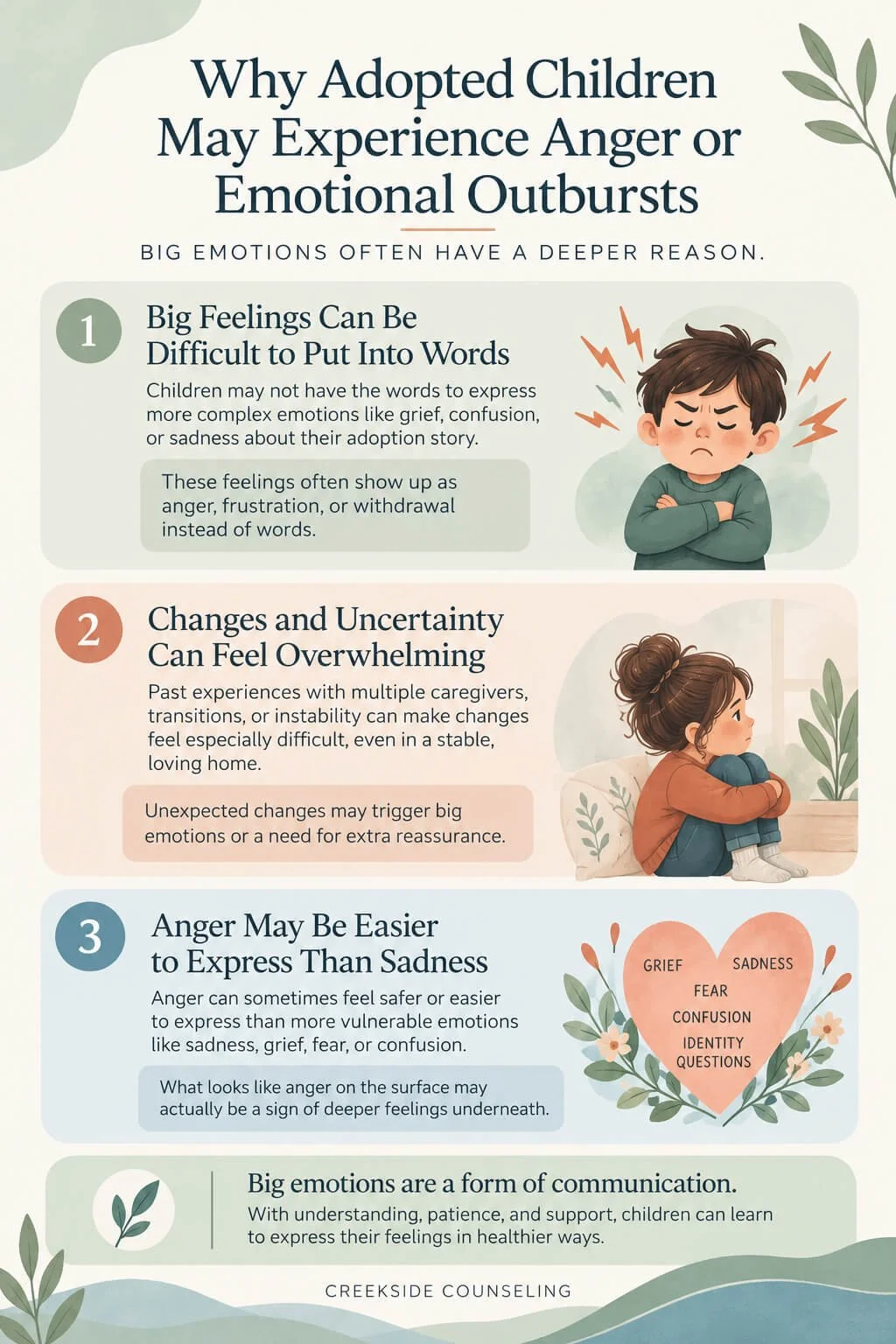
Children don't always have the language to explain complicated emotions, and some adoption issues involve feelings related to early loss or separation that a child may not fully recognize or be able to name.
A younger child may not know how to say, "I'm confused about where I came from," or "I feel sad about someone I don't remember."
Instead, you might notice irritability, withdrawal, frustration, or emotional outbursts—sometimes signs of emotional instability, though the underlying causes still need careful understanding.
That doesn't mean every tantrum is connected to adoption. Sometimes children are simply tired, hungry, overwhelmed, or frustrated.
But when big reactions become a pattern, it's worth getting curious about what might be happening beneath the surface and looking for the root cause rather than assuming every outburst means the same thing.
2. Changes and Uncertainty Can Feel Overwhelming
Some adopted children have experienced significant changes in caregivers, routines, or living environments, and repeated moves or multiple placements before adoption can increase trauma risk for some children.
For children with these experiences, unexpected changes may sometimes bring up feelings of uncertainty or a need for reassurance.
A last-minute schedule change or an unfamiliar babysitter might feel particularly difficult, even when the child is currently living in a stable environment.
Predictability and preparation can help children feel more secure and regain a greater sense of control after earlier instability.
3. Anger May Be Easier to Express Than Sadness
Anger can sometimes be a more accessible emotion than grief, fear, embarrassment, or vulnerability, even when sadness, fear, or other feelings may still be present underneath and the child is not fully aware of them.
For example, a child who becomes upset when classmates ask questions about their adoption may actually be feeling exposed, confused, or uncomfortable.
Instead of focusing only on stopping the anger, try helping your child identify the feelings underneath it so they can develop healthier ways of coping over time.
You might say, "I noticed you seemed really upset after that conversation. I wonder if something about it felt uncomfortable."
Give them space to disagree or offer their own explanation.
Adopted Child Anxiety: What Adoptive Parents May Notice
Adopted child anxiety can look similar to anxiety in any other child. Some children worry excessively, seek reassurance, avoid unfamiliar situations, or experience physical symptoms like stomachaches and headaches. Some adopted children—especially those with trauma histories—may also be at higher risk for post traumatic stress disorder.
Depending on their experiences, an adopted child may also have worries related to relationships, separation, belonging, or uncertainty.
Possible signs include:
Frequent worries about being separated from caregivers
Difficulty with unexpected changes
Repeatedly seeking reassurance
Trouble sleeping or frequent nightmares
Avoiding unfamiliar people or situations
Becoming highly distressed by mistakes or conflict
Worrying about whether relationships will last
These signs don't automatically mean a child has an anxiety disorder, and they aren't unique to adopted children.
If anxiety is persistent or interferes with school, friendships, family life, or everyday activities, a child therapist can help determine what support may be beneficial. This can be especially important for children who spent time in foster care, since foster children are at high risk for developing PTSD.
Adoption, Identity, and the Need to Belong
As children grow, they naturally become more curious about who they are and where they fit in.
For adopted children, identity development may include additional questions about biological relatives, family history, cultural heritage, and their adoption story.
These questions can become particularly important during the preteen and teenage years, when identity and belonging are already major developmental themes. At the same time, many adopted children are doing well overall, and 85% of adopted children report excellent health compared with other children.
For transracial adoptees, questions about identity may also involve race, culture, representation, and experiences of feeling different from family members.
Children may wonder:
Why don't I look like the rest of my family?
What were my birth parents like?
Do I have siblings?
Why was I adopted?
Where do I belong?
Is it okay to want to know more about my biological family?
Parents sometimes worry that encouraging these conversations will make their child feel less connected to their adoptive family.
But giving children permission to explore their identity doesn't diminish their place in your family.
You can support your child's sense of belonging while also honoring the people, cultures, and experiences that are part of their story.
6 Ways to Support an Adopted Child With Big Emotions
Understanding the possible reasons behind your child's behavior is helpful, but parents also need practical tools for everyday situations.
Here are six strategies that can support emotional regulation, connection, and healthy communication.
1. Validate Their Feelings Without Trying to Fix Them
When your child expresses sadness, anger, or confusion about adoption, your instinct may be to reassure them that they're loved, but validating all emotions—not just the easy or positive ones—is essential for an adopted child's emotional health.
While reassurance matters, immediately shifting toward the positive can unintentionally make children feel that their difficult emotions aren't welcome.
Instead of:
"But you have such a wonderful family now!"
Try:
"It makes sense that you have questions about that. I'm here if you want to talk."
You don't need to solve every emotion. Sometimes the most helpful response is simply allowing your child to experience it without judgment, which can help them feel secure enough to share difficult feelings.
2. Stay Curious About What's Beneath the Behavior
When your child has a big emotional reaction, try asking yourself:
What might my child be communicating right now?
Maybe they're overwhelmed by a transition, struggling with a friendship, worried about separation, or simply exhausted after a long school day—or their behavior may reflect trauma, early neglect, abuse, or current stress, rather than any single adoption-related explanation.
Rather than immediately asking, "Why are you acting like this?" try:
"I can see you're having a hard time. Do you want to tell me what happened, or would you rather take a minute first?"
Curiosity helps parents stay open to what may be driving the behavior, rather than assuming attachment issues explain the whole story.
3. Create Predictable Routines and Follow Through
Consistency can be especially helpful for children who have experienced significant transitions or uncertainty.
Simple routines, such as regular bedtime rituals, family meals, and predictable school-day transitions, can help children know what to expect.
If plans change, give your child advance notice when possible.
For example:
"Grandma is picking you up from school tomorrow instead of me. I'll be home when you get there, and we'll have dinner together."
You don't need to prevent every unexpected change. The goal is to help your child experience change with support and reassurance.
4. Make Adoption Conversations an Ongoing Part of Family Life
Children shouldn't have to initiate every conversation about adoption, and some children may not recognize or talk about adoption issues unless a parent makes room for them.
Create opportunities for age-appropriate discussions about their story, family history, and questions.
You might bring up a relevant topic while reading a book, looking at family photographs, or talking about different kinds of families.
Keep these conversations open-ended rather than expecting your child to share a particular feeling.
For example:
"Some kids who are adopted have lots of questions about their birth families, and others don't think about it very often. Either is okay. You can always ask me questions." A child may also resist calling a struggle adoption-related, even when those feelings connect to their story, so an adoptive mother can help by staying curious and calm.
It's also important to be honest about what you know and what you don't know, rather than filling in missing details with assumptions; when known, details about the birth mother or biological mother during pregnancy can sometimes help answer later questions about what the mother experienced and how that may relate to a child's history.
5. Help Your Child Build Emotional Regulation Skills
Children often need help learning how to recognize emotions and manage them before they become overwhelming, and some may also have attachment issues that make regulation harder.
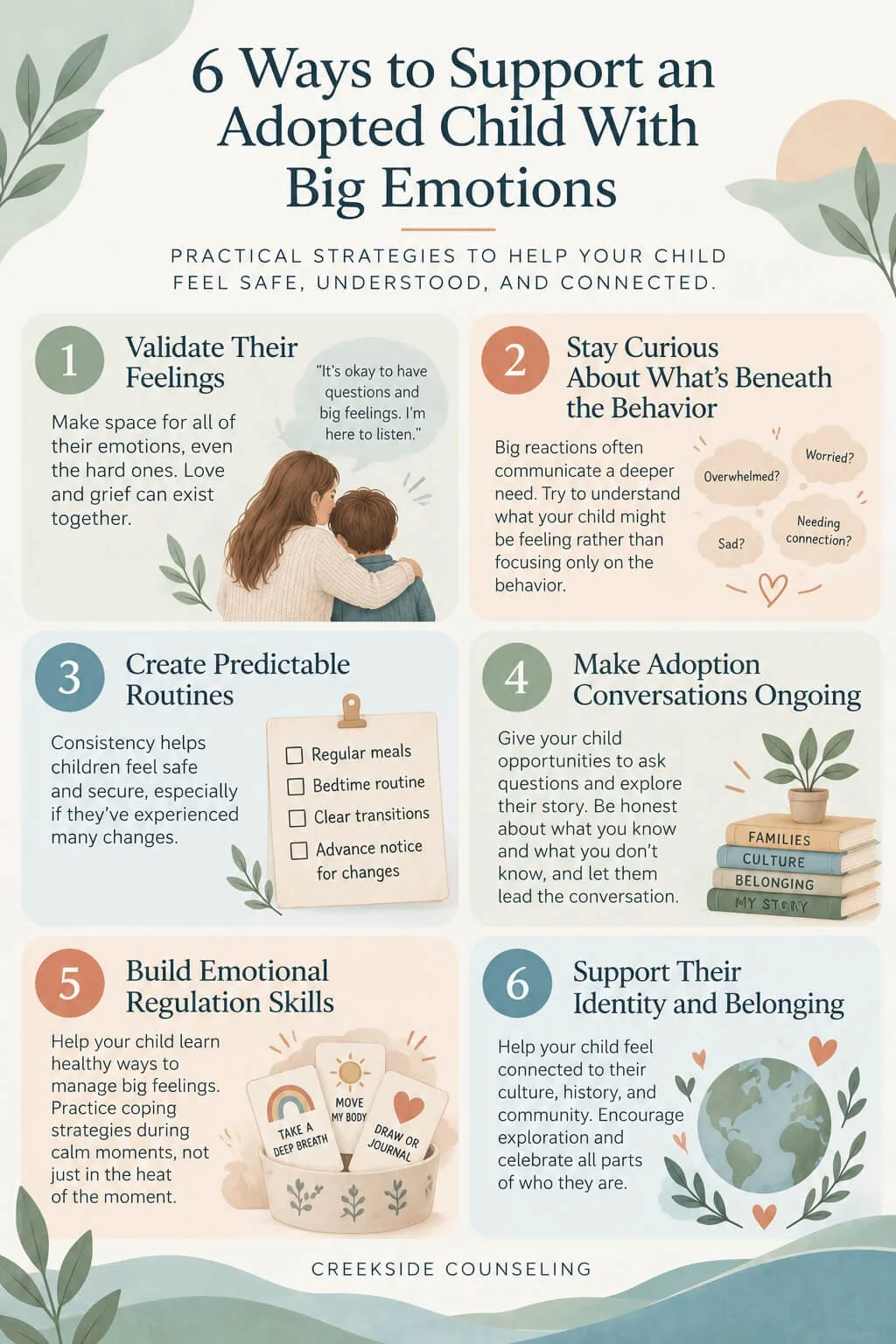
Practice coping strategies during calm moments, not only when your child is upset.
Depending on their age, you might try:
Naming emotions and noticing where they feel them in their body
Taking a short movement break
Drawing or journaling about feelings
Practicing slow breathing together
Creating a quiet space where they can reset
Role-playing difficult conversations with peers
Offering choices when your child feels overwhelmed
When emotions escalate, focus on helping your child feel safe and regulated before trying to problem-solve. In some adoptees, reactive attachment disorder can complicate emotional stability, but many children with big behaviors are not accurately described by that diagnosis alone, and the impact can matter differently from one child to another.
And remember that validating feelings doesn't mean removing boundaries. You can acknowledge anger while still setting limits around hitting, yelling at others, or unsafe behavior.
6. Build Connections to Their Identity and Community
For some adopted children, particularly transracial adoptees, meaningful connections to their cultural heritage and others with shared experiences can support identity development. When safe and appropriate, healthy relationships with both adoptive and birth family connections can also support that process over time.
This might include relationships with people who share their racial or cultural background, learning about family history, participating in cultural traditions, or connecting with adoptee communities.
These connections should be genuine and ongoing rather than occasional activities intended to check a box.
Follow your child's interests and comfort level, and recognize that their relationship with their adoption story may change as they grow.
When Should You Seek Therapy for an Adopted Child?
Not every adopted child needs therapy simply because they were adopted.
However, therapy can be helpful when emotional or behavioral challenges are persistent, overwhelming, or affecting daily life, and adoption-informed counseling can make a huge difference for some families.
Consider reaching out for support if your child is experiencing:
Frequent or intense emotional outbursts
Ongoing anxiety or separation worries
Significant difficulties with friendships or family relationships
Persistent sadness, withdrawal, or low self-esteem
Behavioral challenges that are affecting school or home life
Difficulty processing adoption-related grief, loss, or identity questions
Distress related to past experiences, unresolved trauma, feelings of abandonment, or major life transitions
A therapist with experience in adoption-related concerns can help your child explore their emotions without making assumptions about what adoption means to them. Therapy may also include parent support to help caregivers better understand their child's needs, identify the underlying concerns, strengthen communication, help a child feel more secure, and move forward with more hope.
At the same time, adoption is not always the sole explanation for every struggle, so careful assessment should consider the whole child.
Adoption-Informed Child Therapy in Eden Prairie, Minnesota
At Creekside Counseling, we understand that every child's story is unique. Some children need support managing anxiety or big emotions, while others are working through questions about identity, belonging, relationships, or past experiences.
Our therapists provide compassionate child therapy and parenting support for families in Eden Prairie and throughout the Twin Cities, including Chanhassen, Minnetonka, Edina, and Chaska.

Meet Alyse Yoder, MSW, LICSW
Alyse has a special interest in supporting adoptees, including transracial adoptees, as they navigate identity exploration, relationships, anxiety, and life transitions. As a Korean American adoptee herself, she brings both lived experience and a compassionate, nonjudgmental approach to conversations about adoption, grief, and belonging.
Whether your child is experiencing big emotions, struggling with relationships, or beginning to explore questions about their adoption story, we're here to help your family feel supported.
Frequently Asked Questions About Adoption and Children's Emotions
Is it normal for adopted children to struggle with anger?
Yes, anger is a normal emotion for all children, including adopted children. However, some adoptees may experience additional feelings related to grief, loss, identity, or uncertainty that can contribute to emotional outbursts. Rather than assuming anger is caused by adoption, it's helpful to explore what your child might be feeling and what support they need.
Why does my adopted child push me away when I'm trying to help?
Children sometimes withdraw, reject comfort, or push caregivers away when they're overwhelmed. For some adopted children, past experiences with separation or changes in caregivers may influence how comfortable they feel accepting support. Try remaining calm, respecting their need for space, and reassuring them that you're available when they're ready to reconnect.
Can adopted children experience trauma even if they were adopted as babies?
Some children adopted as infants may have experienced early stress, medical complications, or separation from familiar caregivers, but adoption during infancy doesn't automatically mean a child has experienced psychological trauma. Every child's history and response are different. If you're concerned about your child's emotional development, a therapist familiar with adoption and early childhood experiences can help you better understand their needs.
How can I help my adopted child feel secure and loved?
Consistency, emotional validation, and open communication can help strengthen your child's sense of security. Follow through on promises, maintain predictable routines, and make space for conversations about their adoption story. Most importantly, remind your child through both words and actions that all their feelings are welcome, including difficult ones.
Should I talk to my child about their adoption if they don't bring it up?
Yes, age-appropriate conversations about adoption can help children understand that their story isn't something they need to avoid or keep secret. Look for natural opportunities to discuss family history, identity, and belonging without pressuring your child to share. Let them know they can ask questions whenever they're ready.
When should I consider therapy for my adopted child?
Consider child therapy if your child experiences ongoing anxiety, intense emotional outbursts, persistent sadness, relationship difficulties, or behavioral challenges that interfere with everyday life. Therapy can also provide a supportive space for exploring adoption-related grief, identity questions, and family relationships. Your child doesn't need to be in crisis to benefit from additional emotional support.

About the Author
Elisabeth Emmerich, MSW, LICSW, is the owner and founder of Creekside Counseling, where she helps children, parents, and adults build healthier relationships with themselves and those they love. As a mom of three, she understands firsthand the challenges of balancing family life, mental health, and the pressures of everyday life, bringing both professional expertise and personal understanding to her work.