


Why do some parenting moments feel so much bigger than they "should"?
Have you ever found yourself reacting more strongly than you expected when your child ignores you, throws a tantrum, refuses to listen, or melts down over something seemingly small?
Maybe you've caught yourself thinking:
"Why does this bother me so much?"
"I know they're just being a kid, but I can't stay calm."
"I don't want to yell...but I feel like I'm about to explode."
If you've ever felt triggered by your children, you're not alone.
As therapists who specialize in parenting, child therapy, and trauma therapy, we want parents to know something important: becoming emotionally triggered doesn't mean you're a bad parent. It often means your own nervous system is responding to something deeper than the situation happening in front of you.
Our children have an incredible ability to activate parts of ourselves we didn't even realize needed healing. The good news is that awareness creates opportunity. When we understand why certain behaviors affect us so deeply, we can begin responding differently—not only for our children, but for ourselves as well.
In this article, we'll explore why parents sometimes feel triggered by their child's behavior, how your own experiences shape your reactions, and practical trauma informed parenting strategies that can help you stay calm, connected, and confident.
What Does It Mean to Feel Triggered by Your Child?
Being triggered isn't simply feeling annoyed or frustrated.
A trigger is an emotional response that feels much bigger than the situation itself (source).
When parents become emotionally triggered, their nervous system often reacts as though there is danger—even when there isn't.
You may notice:
Your heart racing
Tightness in your chest
Feeling overwhelmed
An urge to yell
Wanting to walk away
Shutting down emotionally
Feeling out of control
Instead of responding thoughtfully, you're reacting automatically. This isn't because you don't love your child.
It's because your brain has temporarily shifted into survival mode. In that state, fear can create a strong sense of danger or alarm.
Why Your Child's Behavior Feels So Personal
Children naturally test limits.
They cry.
They argue.
They make messes.
They ignore instructions.
They have big emotions.
These behaviors are all part of healthy development. So why do they affect some parents more than others?
Because our reactions are shaped by our own experiences. Sometimes a child's behavior activates old beliefs such as:
"I'm failing."
"I'm losing control."
"People will judge me."
"I have to fix this immediately."
"Good parents shouldn't have children who act like this."
These beliefs often develop long before we ever become parents.
How Your Own Childhood Influences Your Parenting
One of the core principles of trauma informed parenting is recognizing that we all bring our own childhood experiences into the way we parent. Whether we realize it or not, the way we were comforted, disciplined, encouraged, or even ignored helps shape how our nervous system responds to stress today.
For example, if you grew up in a home where emotions were dismissed, you may find it especially difficult to stay calm when your child has a meltdown. If mistakes were met with criticism, your child's misbehavior may leave you feeling like you've somehow failed as a parent. And if love or approval felt conditional, your child's rejection or defiance can trigger feelings that seem much bigger than the moment itself.
These reactions don't mean you're parenting incorrectly. They simply remind us that our own stories don't disappear when we become parents. Instead, they often resurface when our children express the very emotions or behaviors we weren't given space to experience ourselves.
The encouraging news is that awareness creates the opportunity for change. As you begin to understand your own triggers, you can respond more intentionally, break unhealthy patterns, and create the kind of secure, connected relationship you want with your child.
Why Trauma-Informed Parenting Matters
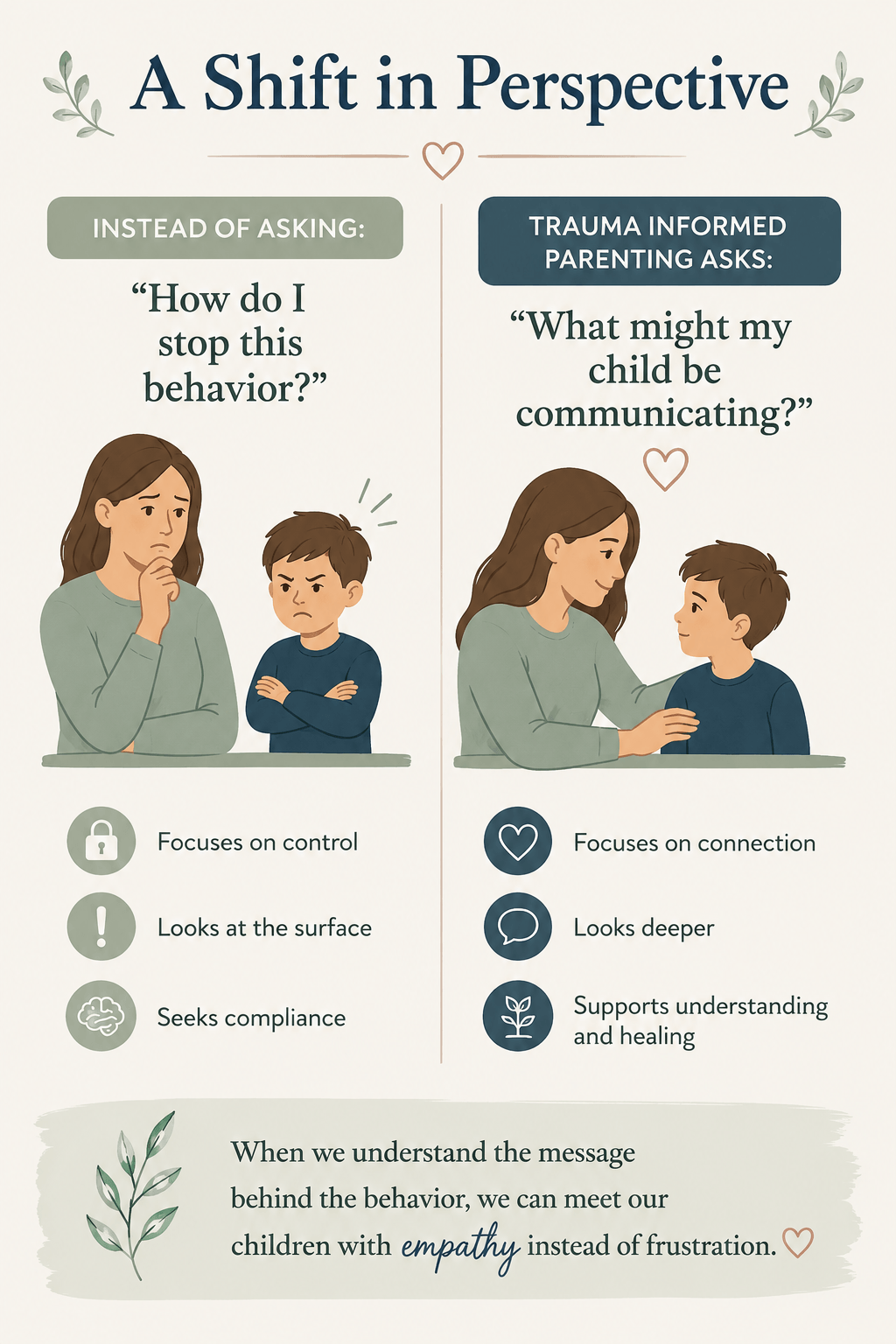
Trauma informed parenting doesn't mean assuming every child has experienced significant trauma.
Instead, it means recognizing that challenging behaviors always have meaning, and that understanding trauma helps you look beyond the surface.
Rather than asking:
"How do I stop this behavior?"
Trauma informed parenting asks:
"What might my child be communicating?"
A trauma informed approach looks for root causes, underlying emotions, unmet needs, and underlying needs rather than only trying to stop the behavior.
That small shift changes everything.
Children don't need parents who never get frustrated. Children who have experienced trauma may rely on coping mechanisms that once helped them manage difficult experiences.
They need trauma informed parents who become curious before becoming reactive.
Signs You May Feel Triggered by Your Child's Behavior
Parents often tell us they feel especially activated by behaviors that are actually a normal part of childhood development. Things like testing limits, expressing big emotions, or needing repeated reassurance are all ways children communicate that they're still learning how to navigate the world.
You may notice yourself feeling especially triggered when your child:
Ignores directions
Talks back
Has a public meltdown
Cries frequently
Becomes physically aggressive
Makes the same mistake over and over
Needs constant reassurance
Struggles with transitions
While these behaviors can certainly be exhausting, they're not always a sign that something is wrong. In some cases, they may simply reflect your child's developmental stage. In others, they may be influenced by anxiety, sensory differences, trauma, or other emotional needs. Whatever the cause, they're often a form of communication rather than intentional misbehavior.
When you find yourself reacting intensely, pause and ask yourself:
"Is my reaction matching the size of the problem?"
If the answer is no, your nervous system may be responding to something deeper than what's happening in the moment. Recognizing that connection is one of the most important trauma informed parenting skills, because it creates space to respond thoughtfully instead of reacting automatically.
Trauma-Informed Parenting Strategies That Actually Help
The goal isn't to never get triggered.
The goal is learning how to respond differently when you do.
This is a process and part of the healing process for both you and your child, which can strengthen your relationship over time.
Pause Before You Respond
When emotions rise, use deep breathing and take one of those deep breaths before speaking.
Creating even a small pause gives your thinking brain time to catch up with your emotional brain. If possible, step away for a few minutes before re-engaging so you can stay calm and respond more thoughtfully.
Notice What's Happening in Your Body
Your body often recognizes a trigger before your mind does.
Pay attention to:
racing heart
clenched jaw
shallow breathing
tense shoulders
These physical cues are early warning signs that your nervous system needs regulation.
Get Curious Instead of Critical
Instead of asking:
"Why are they doing this?"
Try asking:
"What might they be needing right now?"
This simple shift encourages connection over control while helping children build emotional awareness and age-appropriate problem-solving skills.
Looking beneath the behavior helps a caring adult understand what may be going on before responding.
Separate Your Story From Your Child's Story
Your child's tantrum is not proof that you're failing. Their anxiety isn't your fault. Their big emotions are not a reflection of your worth as a parent.
Children are still learning emotional regulation. Your role isn't to eliminate every difficult emotion. It's to help them move through those emotions safely.
Repair When Things Don't Go Well
No parent stays calm all the time. Even the most patient parents have moments when they raise their voice, react out of frustration, or wish they had handled a situation differently.
The goal of trauma informed parenting isn't perfection—it's repair. When you acknowledge what happened and reconnect with your child, you're teaching them that relationships can withstand mistakes and be strengthened through honesty and compassion.
That repair might sound like:
"I'm sorry I yelled. I was feeling overwhelmed, and I wish I had handled that differently. Let's try again."
These conversations model accountability, emotional regulation, and resilience and creates a sense of psychological safety. They also help children learn that conflict doesn't have to lead to disconnection and that mistakes can be followed by understanding and reconnection.
In many ways, repair is more powerful than perfection because it teaches children one of life's most important lessons: healthy relationships aren't defined by never making mistakes—they're built by coming back together after them.
When Parents Need Support Too
One of the biggest misconceptions about parenting is that parents should already know how to do this. But parenting doesn't come with a manual.
Sometimes the hardest part isn't your child's behavior. It's the way that behavior interacts with your own stress, anxiety, past experiences, or trauma.
Working with a therapist can help parents:
understand their triggers
regulate their own emotions
build healthier parenting patterns
strengthen attachment
reduce family conflict
develop coping strategies when past trauma or a mental health condition is shaping parenting reactions
keep a journal to notice which specific behaviors trigger intense reactions
Professional support can also help you prioritize self care, practice self compassion, and support setting boundaries to protect your mental health and well being.
It can also help create steadier daily routines and a more predictable home environment; a healing environment is built on consistency and predictability.
Seeking support isn't admitting failure, and the right path may include therapy when ptsd symptoms or unresolved traumatic experiences are present.
It's investing in your family's future.
Parenting Doesn't Have to Feel This Hard
If you've ever wondered, "Why do I feel so triggered by my child's behavior?" we hope you leave this article knowing one thing: you're not alone.
Parenting has a way of bringing our own experiences, wounds, and beliefs to the surface. While that can feel overwhelming, it also offers an opportunity to grow—not just as a parent, but as a person. As you begin to recognize your triggers and practice trauma informed parenting skills, it becomes easier to respond with curiosity instead of frustration, connection instead of control, and confidence instead of guilt.
You don't have to navigate that journey on your own.
At Creekside Counseling, we help parents throughout Eden Prairie and the Twin Cities better understand both their child's behavior and their own reactions to it. Whether you're hoping to strengthen your parenting skills, improve family relationships, heal from your own past experiences, or support a child who's struggling with big emotions, our therapists are here to help.
We also offer Circle of Security® Parenting, an attachment-based parenting program that helps caregivers better understand their children's emotional needs while building stronger, more secure relationships.
If you're ready to feel more connected, more confident, and less overwhelmed in your parenting, we'd love to support you. Contact Creekside Counseling today to schedule a consultation and learn more about our parenting, family, and child therapy services.
Frequently Asked Questions Around Children’s Behaviors & Triggers
Why am I so triggered by my child's behavior?
If you feel triggered by your children, it doesn't mean you're a bad parent. Often, a child's behavior activates past experiences, beliefs, or emotional wounds that your nervous system still associates with stress or danger. Becoming aware of these triggers is the first step toward responding more calmly and intentionally.
What is trauma informed parenting?
Trauma informed parenting is an approach that recognizes that behavior is a form of communication. Instead of asking, "How do I stop this behavior?" trauma-informed parents ask, "What might my child be trying to tell me?" This mindset helps parents respond with empathy, build emotional safety, and strengthen their relationship with their child.
What are some trauma informed parenting strategies I can use at home?
Some effective trauma informed parenting strategies include pausing before reacting, noticing your own physical signs of stress, staying curious about what your child may be feeling, and repairing after conflict. These small shifts help create a sense of safety and connection while teaching children healthy emotional regulation.
When should I seek help if I feel triggered by my child's behavior?
It's normal to feel frustrated as a parent, but if you frequently feel triggered by your child's behavior to the point that it leads to yelling, shutting down, guilt, or ongoing family conflict, it may be helpful to talk with a therapist. Parenting support or family therapy can help you better understand your triggers, develop new coping skills, and build a more connected relationship with your child.