

The Mental Load of Parenting: Why You're Exhausted Even When You're Doing Everything Right

If you've ever wondered, "What is mental load?", you're not alone. The mental load of parenting is one of the most common reasons I see parents feeling overwhelmed, exhausted, and convinced they're somehow falling short—even when they're doing an incredible job.
As both a therapist who works with parents and families and a mom of three myself, I have countless conversations with parents who walk into my office believing they are failing. They tell me they're constantly tired, struggling to keep up with responsibilities, losing patience more quickly than they'd like, and feeling guilty that they aren't more present with their children.
And almost always, they assume the problem is that they aren't doing enough.
What I often see instead is a parent who is carrying an invisible workload that never truly ends.
If you've ever laid awake at night mentally reviewing tomorrow's schedule, remembered a school form that needs to be signed while brushing your teeth, or found yourself managing everyone's emotions while ignoring your own, you're likely carrying the mental load. The truth is that many parents aren't struggling because they're doing something wrong—they're struggling because they're carrying too much.
In this article, we'll explore what the mental load is, why the invisible load of motherhood and parenting can lead to parental burnout, how carrying the mental load affects your well-being, and practical ways to lighten the burden. Whether you're a parent of young children, school-aged kids, or teenagers, you'll walk away with a better understanding of why you're feeling overwhelmed—and reassurance that you're not alone.
What Is the Mental Load and Mental Labor?
When people think about parenting responsibilities, they often think about visible tasks such as driving children to activities, preparing meals, helping with homework, or attending appointments.
But there is another layer of work happening behind the scenes involving all of the mental tasks of every day life with children.
The mental load of parenting refers to the ongoing process of planning, organizing, anticipating needs, remembering details, solving problems, and managing family life. It is the invisible work, also known as the "cognitive labour" that keeps a household functioning.
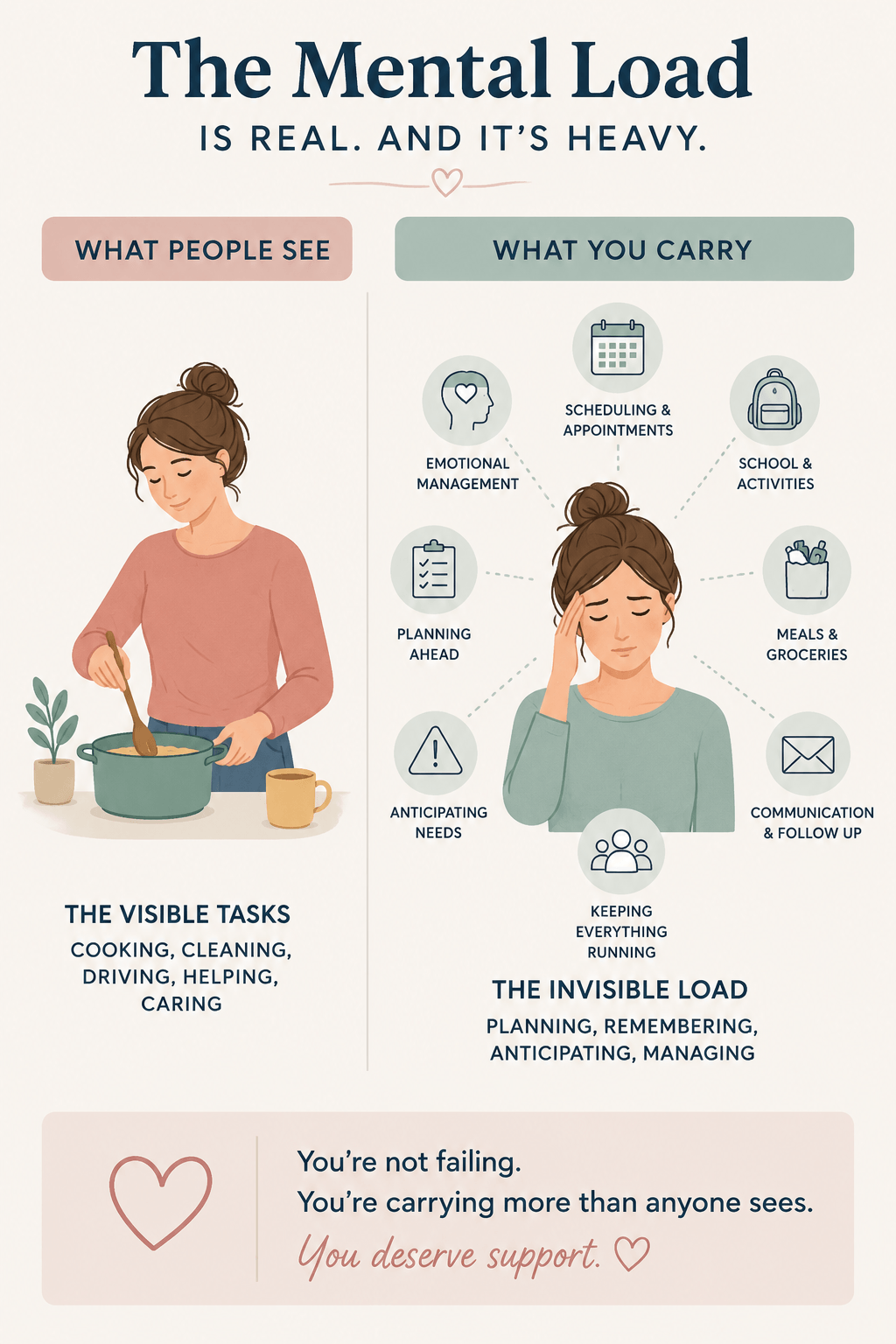
It includes things like:
Remembering upcoming appointments
Scheduling childcare
Monitoring developmental milestones
Keeping track of school events
Managing household routines
Anticipating emotional needs
Coordinating family schedules
Planning meals and groceries
Noticing when someone needs new shoes, medication refills, or extra support
Most of these tasks and household responsibilities never make it onto a checklist because they happen constantly in the background, taking up valuable mental space.
That is why so many parents feel exhausted even when they haven't technically "done" much yet.
The Invisible Load of Motherhood and Gender Equality
Although fathers can absolutely experience parental burnout and carry significant family responsibilities, research consistently shows the gendered nature of this imbalance: in most households, women spend more time on household planning, emotional responsibility, and unpaid work, a pattern long treated as women's work rather than shared gender equality at home.
The invisible load of motherhood extends beyond physical caregiving and includes mental and emotional labor involved in managing domestic life behind the scenes.
Many mothers become the default family manager, especially when one partner informally takes charge and the other partner waits to be directed.
They are often responsible for remembering birthdays, scheduling appointments and storing medical records, coordinating activities, tracking household tasks for family members, monitoring emotions, communicating with teachers, managing family relationships, and keeping track of countless details that no one else notices.
This invisible work requires constant mental energy, and that heavy mental load can feel like a second shift after paid work ends.
Because much of it happens internally, it is often overlooked by others and even minimized by the parent carrying it, even though the mental workload often falls on one person to anticipate needs, make decisions, and keep everything moving.
It is not just doing tasks but acting like a project manager for the home, where one parent may handle the planning and coordination while a partner completes only the visible jobs.
Yet it is frequently one of the biggest contributors to chronic stress and exhaustion, especially when one partner carries the burden and must also create a sense of shared responsibility for the other.
Why Carrying the Mental Load Leads to Burnout and Affects Physical and Mental Health
One of the challenges with carrying the mental load is that there is rarely a clear stopping point, and research shows it remains gendered in ways that reflect unequal unpaid work at home.
Laundry eventually gets folded.
Dinner eventually gets cooked.
But there is no finish line for worrying, planning, remembering, anticipating, and managing.
Many mothers become the default family manager, with one partner often becoming the project-manager person for family members while the other may help with physical tasks without sharing full responsibility or emotional responsibility.
They are often responsible for not only what gets done, but also when, how, and whether anyone else even notices it needs doing. This is a heavy mental load, a form of unpaid labor tied to the second shift more than visible caregiving alone.
Many parents live in a constant state of mental multitasking.
Even during moments that are supposed to feel relaxing, their brains are running through:
What needs to happen tomorrow
Which child needs what
Whether everyone is okay emotionally
What tasks haven't been completed
Upcoming appointments and commitments
This invisible work requires constant mental energy. In dual-income households, women perform about 65% of this mental work, women spend about 21 hours weekly on household management and mental load, and men contribute about 30 minutes to 2 hours daily on household tasks (source).
Over time, this ongoing cognitive load can contribute to parental burnout, decision fatigue, and strain that mental load affects relationships, physical and mental health, mental health, and overall well being.
Parents experiencing burnout may notice:
Chronic exhaustion
Increased irritability
Difficulty concentrating
Feeling emotionally disconnected
Increased anxiety
Less patience with their children
Feelings of guilt or inadequacy
These symptoms can also disrupt decision making, weaken mental well being, and, without enough self care, increase stress-related health issues and long-term risk for chronic disease.
Ironically, many parents blame themselves for these symptoms when they are actually signs that their nervous system has been carrying too much for too long. This imbalance helps explain why women are twice as likely as men to experience severe stress and why support that helps reduce stress matters.
Why Social Media Makes the Mental Load Worse
Today's parents are not only managing their families. They are also managing an overwhelming amount of information.
Every day, parents are exposed to advice about:
Sleep
Nutrition
Screen time
Emotional regulation
Parenting styles
Education
Child development
Much of this information is conflicting.
As a result, parents often feel pressure to constantly evaluate whether they are making the "right" decisions.
The mental load of women today frequently includes not only caring for their families, but also researching, comparing, second-guessing, and striving for impossible standards.
Comparison has become another invisible task.
And comparison is exhausting.
Signs You're Carrying Too Much
Many parents don't realize how much they are holding until they reach a breaking point.
You may be carrying too much of the mental load if:
You struggle to relax even when you have free time
You feel responsible for everyone's emotions
You constantly worry about forgetting something
You feel resentful that others don't notice what you do
You rarely ask for help
You feel exhausted despite getting adequate sleep
You can't remember the last time you focused on your own needs
These are not signs of failure.
They are signs that your brain and body are asking for support.
How to Lighten the Mental Load
There is no quick fix for the mental load of parenting, but there are ways to make it more manageable.
Start by noticing what you're carrying.
Many parents have never stopped to identify the invisible work they do every day so they can eventually delegate tasks.
Once you recognize it, you can begin having conversations about sharing responsibilities more equitably, setting boundaries around commitments, lowering unrealistic expectations, and asking for help.
Most importantly, remember that your worth as a parent is not determined by how much you can carry.
Your children do not need a perfect parent.
They need a connected one.
You Deserve Support Too
One of the messages I wish every parent could hear is this:
You were never meant to do this alone.
Parenting was always intended to happen within a village of support, relationships, and community.
If you're feeling overwhelmed, exhausted, or stuck in a cycle of parental burnout, it may be helpful to seek additional support.
At Creekside Counseling, we work with parents and families who are navigating stress, parenting challenges, relationship dynamics, and the invisible demands of raising children.
Whether through individual therapy, family therapy, or our Circle of Security parenting classes, our goal is to help parents feel more confident, connected, and supported.
Because caring for yourself isn't taking away from your family.
It's one of the most important ways you care for them.
Frequently Asked Questions About the Mental Load of Parenting
What is the mental load of parenting?
The mental load of parenting refers to the invisible work involved in managing family life, including planning, organizing, remembering, anticipating needs, and coordinating schedules. It's the ongoing mental effort that keeps a household running, even when no physical tasks are being completed.
Why do I feel exhausted even when I haven't done much all day?
Many parents spend their days carrying an invisible mental workload that isn't always visible to others. Constantly managing appointments, school responsibilities, emotional needs, household tasks, and future planning can be mentally draining and contribute to parental burnout.
Is the mental load only something mothers experience?
No, any caregiver can carry the mental load. However, research shows that women often take on a larger share of the invisible work involved in managing a family, which is why the invisible load of motherhood is a common topic among parents and mental health professionals.
How can I reduce the mental load and prevent parental burnout?
Start by identifying the responsibilities you're carrying, communicating your needs with supportive family members, setting realistic expectations, and asking for help when needed. Therapy, parenting support groups, and programs like Circle of Security can also help parents feel more confident, connected, and supported.